2025-26 NBA Team Previews
One team per day, every day for 30 days. Full blog + charts below.
Philadelphia 76ers
2024-25: 13th in East · 24-58
Oh boy. This team, this city, this franchise. It’s hard to know where to even begin discussing the Philadelphia 76ers. Let’s start here: it’s going to be very hard for the Sixers to do worse this season than they did in 2024-25. If nothing else, expect something marginally better — but beyond that, it could go in all sorts of directions for Philly.
After a year from hell that saw the roster ravaged by injuries, age, and internal drama — much of it concerning franchise center and former MVP Joel Embiid’s health and availability — the Sixers have a lot to figure out if they want back into the thick of things at the top of the East.
The challenges all start with Embiid, whose health and relationship with the front office have stagnated to a concerning degree in recent seasons, even as he signed a three-year, $193 million contract extension in September 2024, including a player option for the 2028-29 season.
Embiid’s decline from his MVP season in 2023 has been dramatic — if perhaps predictable, given the arc of his career and how he’s been handled in Philadelphia. Drafted third overall in 2014, Embiid became the poster child for the franchise’s controversial “Trust the Process” approach, both a beneficiary and a victim of a culture that prioritized long-term development and draft capital over on-court results for too many seasons.
That lose-now-to-win-later mindset allowed Embiid to sit out his entire rookie season, as well as several other long stretches in the years since. More often than not during his 12 seasons as a Sixer, he’s been able to pick and choose when — and how — he plays, at least according to his critics. The result is a toxic dynamic between an aging, injury-prone big man, his team, and a proud, famously aggressive fanbase that has adored him — until now.
Last season, those long-standing tensions reached a new low. Embiid missed most of the season, and the Sixers finished with a dismal 24-58 record — an especially disappointing result given the high hopes fans and the front office had going into the year. The situation was further compounded by the Sixers’ ill-fated acquisition of veteran superstar Paul George, who also suffered a steep drop in production and missed significant time in his first year in Philly.
The simultaneous decline of Philadelphia’s two highest-paid players — just after both signed massive new contracts — left the front office in an uncomfortable spot, especially given the emergence of a promising young core. On one hand, GM Daryl Morey invested nearly half a billion dollars over the next four years in the two 30-something stars, inking George to a four-year, $212 million deal in July and re-upping Embiid in September. But neither has looked remotely like the player he once was.
George had a career-low season across nearly every statistical category, failing to shoulder the offensive load in Embiid’s absence. His struggles got so severe that he even stopped producing new episodes of his popular podcast midseason to focus on basketball. His health history — like Embiid’s — doesn’t inspire much confidence going forward.
The resources poured into George and Embiid — and the lack of return — would concern any team. But for this Sixers squad, it feels especially risky given the exciting group of young guards they’ve assembled behind them.
Compounding the issue is the promise of that guard group — three players, possibly four if recently re-signed Quentin Grimes continues his late-season surge — who could form the bridge to a post-Process future. Led by All-Star Tyrese Maxey, who posted a career-high 26.3 PPG last season, the trio of Maxey, second-year guard Jared McCain, and rookie dark horse V.J. Edgecombe might tempt Morey to test the trade market for either George or even Embiid.
And you couldn’t blame him if he did. Maxey has been one of the league’s top under-25 guards for multiple seasons now. McCain — though sidelined for most of his rookie campaign with a torn meniscus and set to miss the start of this season with a UCL tear — showed poise, scoring touch, and star potential in limited action. And Edgecombe, despite being a rookie, has impressed so much in early returns that he looks poised to crack the starting lineup by season’s end. All three, along with Grimes, are under 25 and far more affordable to retain and build around than the aging stars ahead of them.
That promise has only grown in the early weeks of the new season. Maxey currently leads the league in scoring, and Edgecombe is playing like a legitimate Rookie of the Year contender. It’s too soon for victory laps, but their hot start has pushed the Sixers to a 4-0 record and back into relevance — at least for now.
Still, it’s far from certain that the Embiid era is over — or even that Embiid himself can’t return to form. While rare, there is precedent for injury-plagued bigs over 30 finding a second wind (see: Al Horford, Brook Lopez). Just two seasons ago, Embiid averaged more points than minutes. His midrange game might still be the best in the NBA. He can stretch the floor, overpower defenders, and move as well as any big man — if healthy.
Even half that player would be a formidable starting center.
But as always in Philly, the question remains: “If Embiid’s healthy…”
The Sixers’ 4-0 start and Maxey’s MVP-level play are promising, but the fate of their season — and their era — still hinges on the health and productivity of the big Cameroonian. If Embiid can claw his way back to even 75 percent of what he was two years ago, this team could be a legit Finals threat in a wide-open Eastern Conference. Based on what we’ve seen so far, he’s still got a long way to go.
But if he gets going? Look out.
Atlanta Hawks
2024-25: 9th in East · 40-42
It’s been an underwhelming stretch since the Atlanta Hawks last made waves in the East with their surprise Eastern Conference Finals appearance in 2021. Four years ago, this team and its star point guard, Trae Young, felt like they were trending toward consistent contention in the East this decade.
But the best-laid plans of mice and NBA GMs often go astray, and so did the contention dreams of Hawks fans following their loss in the ECF to eventual champion Milwaukee. The past four seasons have been a cavalcade of mismanagement and mediocrity, with Atlanta posting a 160-168 record in that time and failing to build on their 2021 success. But now, after a series of shrewd offseason moves, the Hawks look to break back into the hunt for playoff relevance.
The problems and the promise of this team, as presently constructed and throughout this era of Atlanta basketball, start and end with Young. As one of the league’s most skilled offensive players and one of its most diminutive in stature, “Ice Trae” presents a uniquely vexing team-building challenge. How do you build a modern, 2020s NBA contender around a 5’11” pinball of a pure point guard whose superstar offensive skills are offset by his distinction as one of the league’s worst defensive players? Add to that a troublesome tendency to alienate and frustrate teammates and coaches alike, and the front office has in Young a truly unparalleled team-building quagmire. For every good thing he adds to his team, he always seems to take at least one thing away from it.
But there have been signs of progress in recent seasons from the star guard. A perpetual sieve on defense, Young has shown increased effort and consistency on that end of the court in the past two seasons, suggesting he is taking the criticisms around the league seriously and wants to do all the right things to address his glaring Achilles' heel. Furthermore, the polarizing playmaker has in recent seasons ceded some (key word: some) of the offensive creation responsibilities to teammates like DeJounte Murray (now in New Orleans) and rising star forward Jalen Johnson, showing a willingness to downplay his own heliocentric offensive style for the sake of team success.
If those trends can carry into this coming season—and with Young’s trade value around the league and job security with the Hawks both at all-time lows, per league sources—he has more incentive than ever to show improvement. This could be a pivotal season for him to prove he can be “the guy” the Hawks can build a contender around.
As for the roster around Young, that too gives reasons to be optimistic that this will be the year Atlanta gets back on track. The front office made a series of savvy, ambitious moves this offseason. Chief among these was the bargain trade new GM Onsi Saleh made for injured All-Star center Kristaps Porzingis, who joined Atlanta after winning a championship in 2024 with the Boston Celtics. If he can stay healthy—a big if, given his injury history and the recent mysterious illness during the Celtics’ 2025 playoff run—the 7’3” Latvian could add a potent pick-and-pop dimension to Trae and the Hawks’ ball screen offense.
In addition to Porzingis, the Hawks also nabbed guard Nickeil Alexander-Walker, a key bench contributor on back-to-back conference finals Timberwolves teams, and sharpshooter Luke Kennard, who could help Head Coach Quin Snyder bolster a bench that has been a weak point in recent seasons.
Combine these additions with the return from injury of rising star Johnson and the make-or-break nature of this season for Young’s legacy in Atlanta, and it would appear this team has all the ingredients it needs to make a real run at the East this year. Whether the Hawks capitalize on that potential will ultimately depend on the kind of season Young delivers and how well he fits with the new pieces—and the extent to which the team can stay healthy, on the court and consistently productive. Some big ifs, to be sure, but despite those questions, things are looking brighter and better for Atlanta than they have in several years.
Early season showings have not exactly boosted confidence in this Hawks team’s ability to get over the hump and compete, however. Porzingis’ health is fine, but his tendency to pick and pop and spot up—as opposed to getting his offense inside as a roll man or via post-ups—has led to a drop in team rebounding. Young remains as polarizing an on-court presence as ever, and newcomers Kennard and Alexander-Walker have underwhelmed off a bench that still lacks depth and production.
As a result of those early trends, the Hawks remain, as ever, a .500 team early in this new NBA season.

Boston Celtics
2024-25: 2nd in East · 61-21
The seemingly unstoppable 2023–24 champs limped their way out of the playoffs early last season. Some did so quite literally, as with star Jayson Tatum, who tore his Achilles in the Celtics’ second-round series loss to the New York Knicks and is now likely to miss most, if not all, of this coming season. With Tatum out and key starters from the 2024 champion squad — Kristaps Porzingis and Jrue Holiday — traded in the offseason, this year’s Celtics are going into the season with lowered expectations and a bunch of new faces playing alongside remaining All-Stars Jaylen Brown and Derrick White.
Without Tatum, Porzingis and Holiday, the Celtics will look like a completely new team. Led by Brown, buoyed by White and reigning Sixth Man of the Year Payton Pritchard, Boston will still have a few of its heavy hitters in the starting lineup. But judging by the state of their roster and early performances to start the season, this team seems to lack the star power and balance of its championship contenders in recent years.
What can we expect from these new-look Celtics? For one, lots and lots of 3s: The Celtics shattered league records last season for 3-point attempts, and that was before losing most of their size and slower, less perimeter-bound offensive options. In the absence of Tatum, Porzingis and Holiday, expect the team that shot the most 3s in league history last year to attempt even more per game this coming season. We’re talking upward of 50 3s attempted per game, and a math challenge for any opposing team to solve regardless of the personnel Boston is able to field. That kind of audacious offensive approach could offset the loss in on-court talent, but it will also open the door to wide variance in outcomes night to night (bettors, beware).
Boston Celtics Shot Maps 2024–25
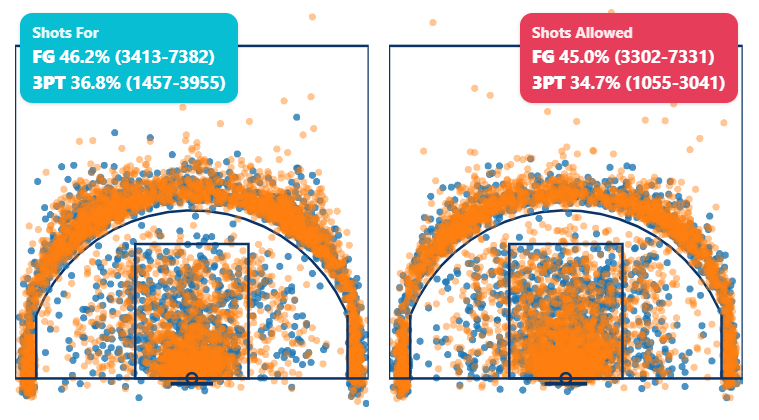
Beyond the 3s, look for a big jump in scoring from Brown in the absence of his longtime running mate, Tatum, who led the team in scoring and rebounding each of the last two seasons. In his nine seasons in the league — all in Boston — Brown has averaged just under 20 points per game on 14.9 field goal attempts, forming with Tatum one of the league’s most potent offensive duos of this era. Now, for the first time since his rookie season in 2016–17, in which he notably did not start or play many minutes, Brown gets to lead this team without Tatum’s assistance or share of the offensive load.
As a longtime Brown believer, I want to believe this will translate automatically to at least +5 PPG this season on equivalent efficiency and shooting splits, but that’s by no means guaranteed. For one, as many in the league have pointed out, Brown has limitations on offense that could make the transition from No. 2 option to go-to scorer tricky — particularly his ball handling and playmaking, which have always fallen short of what’s expected from a star of his caliber. Even after some improvements in recent seasons, Brown remains frustratingly prone to coughing up the ball, dribbling off his feet, making errant passes or simply picking up his dribble too early and in too much traffic. To maximize Boston’s potential this season without Tatum will require a more careful, steady and responsible effort as a playmaker than Brown has historically shown.
He’ll have plenty of help in that department in the Celtics’ backcourt, however. White and Pritchard are as reliable a duo of secondary guards as you’re likely to find in the league short of the All-Star class, and their steady shooting and playmaking will be supplemented by newcomer Anfernee Simons, who brings a potent shot-making punch and youth off the bench (presumably, though he could land in the starting lineup at some point) for a team that already has quite a lot of perimeter firepower.
What Brown and the rest of the Celtics’ core won’t be able to count on in 2025–26, though, is the consistent rebounding and defense the team has sustained for much of this decade. Without Tatum, Porzingis and Holiday — who not only contributed much offensively to Boston’s championship teams but also served as primary cogs in those squads’ suffocating defenses — the Celtics will lose much of what made them a perennial top-tier defense in the Tatum-Brown era. Rebounding and rim protection, in particular, should see a major drop-off this season, with the Celtics’ two top rebounders last season gone from the team. Holiday’s absence, while less relevant to interior defense and rebounding, will still be felt. Head coach Joe Mazzulla (an all-time NBA character who warrants an entire column of his own at some point) still has two top-tier perimeter stoppers to lean on in Brown and White, but Holiday’s bulldog defense and knack for clutch playmaking on that end of the court will be missed throughout the season — especially on nights when one or both of White and/or Brown are sidelined.
Ultimately, this is not going to be the same Celtics squad that made the Eastern Conference Finals six times during the Tatum-Brown era. But with help from an unleashed Brown — and perhaps a little math magic via record-breaking 3-point attempts — this team doesn’t have to be bad, either. There’s a lot of room between the perennial Finals contender Boston has been and falling into next year’s draft lottery. This could still be a play-in team, maybe even a top-six seed, in what is shaping up to be a very thin Eastern Conference. With the right contributions and enough 3s, a whole lot of possibilities still exist for this year’s Boston Celtics.
Brooklyn Nets
2024-25: 12th in East · 26-56
I will start with a confession: I did not watch more than two or three Nets games all last season. This is not one of those teams I have hundreds of words to write about, and that’s for good reason. Like last year, this season’s Nets team, off to a putrid 0-6 start thus far, remains one of the more confusing, aimless and anonymous rosters this league has to offer. This is a team as full of questions and holes as Brooklyn is full of hipster transplants and artisanal coffee shops, and apart from aspirations to land a top lottery pick in the coming draft, I’m not sure what direction this franchise has in mind at this moment.
Take the team’s 2025 draft class as the most recent and oft-discussed example of what I mean. With five first-round picks going into draft night, most of the league anticipated the Nets would bundle some of those to either move up in the first round, grab additional picks in future drafts, or even the sort of current star player they have noticeably lacked since parting ways a few seasons back with their brief and ill-fated superstar core of Kevin Durant, James Harden and Kyrie Irving.
But rather than trying for any of those sensible, rational team-building paths, GM Sean Marks and his front office decided to keep all five first-round picks in this June’s draft. That choice, in and of itself, would have baffled most league insiders and observers, no matter which players the team actually picked with those selections.
But it was who the Nets took with their record five first-round picks that really bewildered so many around the NBA. All five of Brooklyn’s first-rounders — Egor Demin, Nolan Traoré, Ben Saraf, Drake Powell and Danny Wolf — range in size, potential and position, yet all five project as the same archetype of player, that of non-scoring playmaker. In a league that had never seen one team draft that many first-round picks in a single draft, the Nets’ choice to quintuple down on the same kind of player was one that many took as proof positive that this team has no real direction or vision going into yet another consecutive year of yet another full rebuild.
Beyond draft night, Brooklyn has provided other reasons to be concerned about the current rebuild’s trajectory. For one, the provisioning of the offense last season and, barring injury or an unforeseen breakout season elsewhere on the roster, this coming season as well, to trigger-happy, ultra-confident scoring guard Cam Thomas has not inspired much confidence — particularly given the team’s apparent reluctance to bet on Thomas this offseason in the form of a longer-term contract extension. Thomas, who led the team in scoring with a career-best 24 points per game last season, ended a long standoff between the front office and himself last month by opting for a one-year, $6 million deal that will give him another chance at that big contract he thinks he’s earned this coming summer. With all those new playmakers and only newcomer knockdown shooter Michael Porter Jr. to share scoring responsibilities with, that might prove the smart bet to make.
As for Porter Jr. … sigh. This dude oozes with talent and potential and has already won a title as the perfectly cast sharpshooter next to the league’s best player and playmaker in Nikola Jokic. But he’s on his own now, and without the benefit of Jokic’s all-world passing, it’s a safe bet that Porter Jr.’s flaws will be far more exposed this season in Brooklyn. On court, he’s a 6-foot-10 sniper, but almost entirely useless as a playmaker and off-the-dribble shot creator. And on the defensive end, he tends to look utterly confused and disengaged most nights, so don’t expect much from him on that end, either. And if all of that wasn’t disappointing enough for a player who once drew comparisons to Kevin Durant as a high school phenom, the guy may also be the dumbest and crudest bro in the league — just take a listen to his podcast sometime if you doubt me on that. I’ll give him this much: He seems perfectly cast to help the Nets tank this season and beyond, if that is indeed the franchise’s goal right now.
Having outlined all these reasons for pessimism about the 2025-26 Nets, there are some reasons to hope for a better season in Brooklyn than you might be expecting. Foremost of those would be second-year coach Jordi Fernandez, who defied expectations (and, whether they’ll ever admit it or not, front office hopes for a top lottery pick) last season by way overperforming in his first season as coach. Fernandez was the main reason last year’s Nets proved a more competitive and pesky contest for much of the league than the sum of their parts suggested they’d be. There were many nights over the course of the season when I could not name a single player on the court for Brooklyn, and yet a lot of those nights they went out and really hung with superior opponents.
Under Fernandez’s continued oversight, this Nets team should continue to be a scrappy, hard-playing group of young, unheralded players who aren’t just going to roll over for any team that expects an easy W against them in 2025-26. They might not look like they know what they are or where they’re going, but this is not going to be your 2011-12 Charlotte Bobcats of the infamous 7-59 record. This is a real, albeit random, group of developing talents, and they won’t be pigeonholed into the lottery without putting up a fight for all 82 games.
Charlotte Hornets
2024-25: 14th in East · 19-64
For most of my 15-plus years watching NBA basketball, the Charlotte Hornets have been among the most dysfunctional organizations in the league. Much of that dysfunction, ironically, could be traced to former minority owner and NBA icon—some would say “GOAT”—Michael Jordan. While universally lauded for his accomplishments as a player, Jordan proved to be one of the worst owners and draft decision-makers I’ve seen in my time following the NBA. (Granted, I’m not counting Robert Sarver or Donald Sterling, who famously were forced to sell their teams due to inappropriate personal conduct.)
His drafts, signings and trades—about a decade’s worth—often left Hornets fans baffled. Jordan the owner could seemingly do no right. The result was a long stretch of losing seasons, poor roster moves and questionable draft picks, culminating in just one first-round playoff appearance and two play-in games, all losses.
So, where has all that mismanagement left the Hornets heading into the 2025–26 season? What does this team’s future look like, and what should we expect this year from a core led—generously stated—by mercurial, dazzling and wildly popular guard LaMelo Ball? I wouldn’t call this team a conference contender or even a strong play-in hopeful, but for the first time in years, I’m feeling almost bullish about Charlotte’s prospects.
Ball has rightly drawn criticism for his conditioning, his frenetic and freewheeling playing style, his lack of defensive effort, off-court maturity issues and his inability to stay healthy over a full season. Frankly, most of that criticism has been deserved.
But it’s also true that the frustration surrounding Ball is driven just as much by his tantalizing upside. The things he does on the court—routinely—are things we’ve never really seen before. He’s made Charlotte a consistent League Pass favorite despite its poor records and organizational chaos. And beyond the flair and creativity, he’s 6-foot-8 and athletic as they come at the point guard position. That combination of size, skill and vision is what keeps fans and analysts invested in what he could become.
I count myself among those who still believe in Ball’s potential. One of these seasons, he’s going to figure it out—how to play winning basketball, how to go beyond the viral highlights he’s always delivered. Either that, or Charlotte finally trades him for what would likely be a decent (but not elite) return of picks and players. Personally, I’m betting on the former—and I think this could be the year Ball starts to put it all together.
Three weeks into the season, Ball looks reinvigorated. Through seven games, he’s posting career highs in rebounds, assists and offensive rating per 100 possessions. The Hornets haven’t taken a major leap off the back of his improved play, but they look reenergized with their youth movement and fast-paced, creative offense. Ball has reined in some of his wilder instincts and is showing early chemistry with rookies Kon Knueppel and Ryan Kalkbrenner, as well as veteran combo guard Collin Sexton.
That new trio is part of a more functional supporting cast around Ball. Third-year forward Brandon Miller has shown flashes of All-NBA potential when healthy and is one of my breakout picks for this season. Veteran forward Miles Bridges—despite the serious and disturbing domestic violence case that has understandably tainted his public image—is still a key on-court contributor entering his athletic prime. He also shares established chemistry with Ball. Knueppel, meanwhile, has emerged as a versatile, efficient offensive weapon who fits seamlessly alongside the rest of the core.
Still, there are plenty of reasons to temper expectations. Chief among them is the Hornets’ frontcourt, which remains extremely thin. As of now, it consists of Moussa Diabate, veteran Mason Plumlee and rookie second-round pick Kalkbrenner. Kalkbrenner has impressed early, and there’s real upside there—but he’s still a rookie and can’t be expected to anchor the frontcourt for an entire season without some growing pains.
Unless Charlotte makes a move in free agency or on the trade market, this will likely be the worst frontcourt in the league—a significant ceiling-limiter for an otherwise exciting young roster. That’s a problem, especially for a team that hasn’t exactly been a defensive stalwart in recent years.
Because of that, I’m still predicting a finish in the play-in range at best. Even with Ball’s improvements and the promise of the team’s younger players, this will likely remain a losing—or at best, .500—team in 2025–26.
Still, with new leadership in the front office and ownership suite, and a young, intriguing core, there’s finally a sense of direction. For a franchise that’s spent much of the last decade wandering aimlessly, that’s no small thing heading into the new season.
Chicago Bulls
2024-25: 10th in East · 39-43
It’s hard to think of any team in the league that has embodied mediocrity more in the 2020s than the Chicago Bulls.
The issues this decade for the Bulls began with their March 2021 trade with the Orlando Magic for center Nikola Vucevic. That trade cost the Bulls not only a younger center in Wendell Carter Jr., who has been consistently solid for the Magic, but also the lottery pick that became Franz Wagner, who has emerged as one of the league’s best young forwards since Orlando took him in the 2021 draft.
What did those valuable assets bring in return to the Bulls in the seasons since the trade? Very little, it turned out. Vucevic has never looked like the same player he was in Orlando on the Bulls. Worse, the “big three” he was brought in to complete and compete for titles with – comprised of Vucevic, veteran All-Star DeMar DeRozan and uber-athletic All-Star guard Zach Lavine – never really delivered on their initial promise: in three and a half seasons together, the trio never even made it past the first round, and missed the playoffs altogether in multiple seasons.
That era of Bulls basketball ended unceremoniously last season with the departures of Lavine and DeRozan – both shipped out to Sacramento for disappointing returns in separate trades – along with the trade of fan favorite Alex Caruso to the Oklahoma City Thunder for Josh Giddey, a polarizing 6’8” point guard whose defensive and shooting issues prompted Thunder GM Sam Presti to unload him just three years after taking him in the lottery.
In his first two seasons in the league, Giddey had been tantalizingly productive yet frustratingly flawed, as much a defensive liability and spacing conundrum as a non-shooting guard as he was a passing savant with tantalizing upside and size for his skillset. At the time of the trade just before the start of last season, fans and media alike were skeptical and critical of the trade for Chicago, and more or less stayed that way all year, despite a strong first season in Chicago from the Australian point forward. The Bulls ended yet another season with another loss in the 9-10 play-in game, and after another underwhelming offseason entered the 2025-26 season with little to no hype or expectations.
But three weeks into the new season, something strange and unexpected is happening in the windy city: the Chicago Bulls are top of the conference at 6-1, and playing like a real contender. The signature moment of the Bulls hot start came in last night’s thrilling home win over another surprise early-season upstart, the Philadelphia Sixers. In one of the better games of the season so far, both teams showed why they’ve vaulted to the top of the conference unexpectedly, with big games from young stars on both sides – Tyrese Maxey for the Sixers and Giddey for the Bulls – and a huge comeback by the Bulls ending in a game-winning three by Vucevic.
It was a perfect showcase for both sides, but especially the Bulls, highlighting all the key elements that have driven their hot start: an efficient triple double from Giddey, a clutch winner from the resurgent Vucevic, fast and athletic play from the rest of this young Bulls roster, snappy ball movement and surprisingly strong perimeter defense that has covered over Vucevic’s weaker rim protection in Chicago’s first seven games. It was an impressive, statement win for a team I admittedly had zero hope for going into the season.
After watching the whole game this morning, I have to admit I found myself won over by this young, fun Bulls team, and particularly by Giddey, who was magnificent and made the game winning assist to Vucevic with a gorgeous wraparound bullet pass to the corner after driving into traffic under the basket. His play so far has all but erased his past weaknesses, both on the defensive end and as a shooter (teams are still defending him by going under on everything like they always have, and he’s made them pay for it, shooting a career-best 41 percent from behind the arc on 4.4 attempts per game, to go along with career highs in rebounds, assists and effective field goal percentage). He looks every bit like he’s making “the leap” here, and that could change a whole lot for Chicago.
Moreover, Giddey isn’t the only Bull on pace for a big breakout season so far. 2024 lottery pick Matas Buzelis has looked awesome through seven games after a solid rookie season last year, and looks like he could become something more than just a solid starting caliber forward in this league. The former top high school prospect in what is broadly considered one of the weakest classes in NBA draft history, the lanky Lithuanian is starting to show why he was considered the best of his peers as a teenager. He might have some All-Star appearances in his future, if he stays healthy and keeps adding to his balanced and athletic game – if so, that’s another huge game-changing win for the franchise’s long-term plans.
Throw in improved play so far from other young Bulls players like Ayo Dosunmu (who I’ve always been bullish on, no pun intended) and Patrick Williams and a revival of Vucevic, and you start to understand why these Bulls are off to such a surprisingly strong start. Between Giddey and Buzelis and the other improved showings by this young and athletic supporting cast, you can actually envision a strong future in Chicago for the first time in many years. And that, regardless of what else happens the rest of this season, is a massive move in the right direction for this once dominant but long dormant franchise.

Cleveland Cavaliers
2024-25: 1st in East · 64-18
It has been a couple of interesting seasons for the Cleveland Cavaliers. Dominant in the regular season two years in a row, the Cavs fizzled out in the postseason in anti-climactic fashion in 2023-24 and in 2024-25, prompting some pundits and fans to express skepticism about their legitimacy as a contender in the Eastern Conference.
Last season in particular saw the Cavs dominate all regular season with balanced offense, exceptional pace and shooting and lockdown interior defense throughout the year. But when it came time to prove that campaign wasn’t a fluke or the result of a roster built to succeed more in the regular season than in the playoffs, Cleveland ran into injuries and the surprise buzzsaw that was the Indiana Pacers in this past postseason, and bowed out in the second round with a 4-1 series drubbing courtesy of Indiana’s pace and space offensive machine.
Coming into this season, the expectations for this team have been high but tempered, thanks to their recent disappointing playoff showings, but the consensus has still been that this is a top 2 team in the weak East that has as good a chance as any other team in the conference to make the Finals. So far, nothing I’ve seen from the Cavs has given me reason to doubt that projection, and in fact, I have a feeling this team is going to be better than last season’s 64-18 squad.
My optimism for this team has less to do with their start to this season, which has so far fallen short of their blistering early season success last year, and everything to do with the balance and improved play of a few key players that I’ve seen so far.
With fellow All-Star and backcourt mate Darius Garland out to start the season with a toe injury that he had to get surgery for in the offseason, only making his debut on Wednesday against the Sixers, the team’s go-to scorer, Donovan Mitchell, has upped his output significantly. After a drop in scoring in each of the past two seasons from his career-high 28.3 PPG in his first season in Cleveland, Mitchell has been aces so far, dropping a career-best 31.9 PPG on his best shooting splits ever (57% FG, 45% 3pt, 82% FT). It’s obviously too early to bank on this remaining a career year for the six-time All-Star, but if these stats even come close to holding where they’re at currently, the Cavs will be in great shape, especially once Garland returns to form.
Mitchell’s strong start has been supplemented by a really encouraging revival of newcomer point guard Lonzo Ball, who has looked as good as he’s ever looked to start the season after missing the last three seasons with a complex and scary knee injury that required multiple surgeries and threatened to end his career prematurely. Ball is a perfect complementary backcourt pairing with either of Cleveland’s two star guards, and has been an instant seamless fit in Cleveland’s egalitarian, pass-happy offense. His playmaking, which has always been preternaturally good going back to his famed high school years, is really at home in this offense and could elevate this Cavs team to real playoff success come April, May and June.
With Ball playing like he never so much as scraped his surgically repaired knee, Cleveland has hardly even missed Garland, who has been plagued by one injury after another in critical stretches over the last three seasons. If he can return to the heights he showed in his healthy stretches those seasons, however, this Cavs team suddenly looks like the title contender they seemed like they were all last regular season.
Another big piece of what made the Cavs a regular season juggernaut last season was their two-headed monster duo down low of reigning Defensive Player of the Year Evan Mobley and Jarrett Allen, who have combined to lockdown the paint on defense, dominate the boards and supplement the Cavs pace and space perimeter scoring with efficient and consistent paint points in their time together in Cleveland. Mobley gets the lion’s share of the credit and hype out of Cleveland’s two star bigs, and understandably so, given his freakish athleticism and skill for his frame, his youth and his higher ceiling, but too many fans and pundits have slept on Allen in this era of the Cavs. Last season Allen quietly led the league in offensive rating while also holding opponents to lower shooting numbers in the paint and at the rim than his DPOY teammate Mobley. In my mind, he’s consistently been underrated his whole career in this league, and is just as important to this season’s Cavs chances as Mobley is.
That said, Mobley has a chance to take another leap, particularly on offense, where he’s been a streaky shooter and inconsistent shot creator more often than not in his four seasons in the league. If he can paper over some of his past offensive inconsistencies and weaknesses enough to force defenses to respect him as a shooter and a playmaking big – he has shown at times a scary level of ball control and vision for his size, but has yet to consistently play to that level in those areas – Mobley could skyrocket this Cavs’ title hopes in this season and beyond.
Last but not least, I’d be remiss if I didn’t acknowledge the superb coaching of Kenny Atkinson last year, his first in Cleveland after years as universally lauded assistant coach in Golden State and a successful tenure as head coach of the Brooklyn Nets. Atkinson completely unlocked this team’s potential last season with a new offense that emphasized ball movement and space and fast break points, a style that played to his stars’ strengths and elevated his bench’s play all season. In his steady, shrewd hands, this Cavs team will be sure to maximize their effort and optimize their performance, at least in regular season play. Few coaches have elevated their rosters better than Atkinson has in his career with the Nets and the Cavs, and I expect that to continue this season.
All in all, the 5-3 Cavs are still a formidable force in the Eastern Conference and should only get better over the season as they reintegrate Garland and further develop Mobley’s offensive game. Ball is a perfect addition for them and Mitchell is right in his prime at 29 and playing like it. I expect better outcomes for this team, especially in the playoffs when it counts most… just so long as they can stay healthy with a roster full of key players with significant injury history.
Dallas Mavericks
2024-25: 39-43 · 10th in West
Boy, have I been eager to write about this team.
Let’s get this out of the way: it’s impossible to talk about the 2025–26 Dallas Mavericks without focusing on what they gave up to assemble their current roster. I’m talking, of course, about the infamous, shocking trade of their homegrown, all-world superstar Luka Dončić for Anthony Davis and Max Christie back in February. Then and now, the deal has been widely regarded as one of the worst trades in NBA history — if not the worst. And just a few weeks into a season that began with the Mavs reviving franchise hopes by lucking into the top pick and drafting Duke phenom Cooper Flagg, nothing I’ve seen suggests otherwise.
Don’t get me wrong: I love Flagg’s game. He’s a legitimate Rookie of the Year candidate — though not the shoo-in many expected — and a worthy long-term piece. What I am saying is that this team, as constructed, was never going to be a title contender, no matter the delusions or public comments from beleaguered GM Nico Harrison and head coach Jason Kidd. At the time of the trade, the Mavericks pitched it as a win-now, defense-first move centered around Davis, Klay Thompson and Kyrie Irving — veterans supposedly better suited to chase a ring than Dončić, who, lest we forget, carried this franchise to a Finals appearance less than a year ago.
That trade was lunacy then, and despite the lucky bounce of landing Flagg, it looks even worse now. Just look at the current state of this supposed contender: 2–6, dead last in the ultra-competitive Western Conference they were “built to compete in,” and ranked 30th in both offense and offensive efficiency. Flagg, their franchise centerpiece of the future, has been shoehorned into running point while Irving recovers from an ACL tear. Davis, Lively, Gafford, and Flagg were supposed to form a stacked frontcourt. Right now, it’s just Flagg. It’s a disaster — and someone (maybe more than one someone) is about to pay the price if this continues.
To be fair, injuries are a big part of the dysfunction. But even if healthy, I’m not sure this roster was ever more than a play-in team in today’s Western Conference. Irving, Thompson, and Davis are all deep into their 30s with extensive injury histories that should make any Dallas fan uneasy.
Davis is among the unluckiest stars I’ve seen in terms of health in 15 years following the league. He’s already missed significant time twice since arriving in Dallas. Irving, ever mercurial but immensely gifted, has suffered arguably the worst injury possible for a guard of his type. That ACL tear may have ended his prime — assuming he returns at all. And Thompson, as painful as it is to say (and it really is, considering how beloved and accomplished he is), looks like a shell of his former self. Some nights, he’s so washed I find myself wishing his girlfriend Megan Thee Stallion would suit up in his place. Honestly, she might be a better scoring option right now (I kid — mostly. It’s been that rough for the future Hall of Famer).
But the Mavericks’ problems go deeper than aging stars. Even if Irving, Davis, and Thompson were healthy and playing at their peaks, this team still suffers from a fundamental roster imbalance. Flagg, as good as he is, only amplifies a glaring problem created post-Luka: a glut of frontcourt talent and a dire lack of ball-handling and shot-creating guards. Without Irving, that imbalance is fatal in a conference this deep and dangerous. And no offense, Nico, but signing D’Angelo Russell as a stopgap was never going to solve that.
To make matters worse, even the younger guys haven’t stepped up. Derrick Lively has been bitten by the injury bug, while Caleb Martin and Jaden Hardy have underwhelmed despite staying healthy. From aging stars to misfiring youth to an offense stuck in the mud, all roads lead to the same tragic outcome: Cooper Flagg’s first month as a pro has been overshadowed and undermined by dysfunction all around him.
Flagg should be thriving as a Swiss Army knife at his most dangerous off the ball — cutting, screening, connecting, shooting, rebounding. Instead, he’s been forced into a lead ball-handler role, and he’s clearly less comfortable there. The result? He’s looked less effective than expected and may no longer be the front-runner for Rookie of the Year, despite entering the season as a consensus favorite. It’s a brutal way to start your franchise cornerstone’s career — and a move that threatens both his development and long-term buy-in.
I’m not sure what the short-term fix is here, unless everyone magically gets healthy and turns back the clock. The best-case scenario might actually be trading Davis — yes, that Davis, the one they gave up Luka Freaking Dončić to get. But doing that would almost certainly cost Harrison his job, and maybe Kidd’s, too. Worse still, it would mean conceding total failure on the Luka trade — the most widely derided deal in recent memory — and bracing for a full-scale rebuild around Flagg. And if the dysfunction continues, even that might not be enough to keep him happy in Dallas.
This is as bleak a moment as I can recall for this franchise — and I’ve seen a few. It all traces back to that inexplicable Luka trade. Maybe things improve once players return and Flagg grows more comfortable. But even then, from an organizational and PR standpoint, this is a DEFCON 5 disaster. I wish I could be more optimistic, but as it stands, it’s hard to see anything other than a humiliating rebuild in the Mavericks’ near future.

Denver Nuggets
2024-25: 50-32 · 4th in West
Any conversation about the Denver Nuggets in the 2020s must begin and end with Nikola Jokic. The three-time MVP and human embodiment of a triple double, Jokic has been by far the most dominant and efficient offensive player this decade, and is threatening to contend for the greatest offensive career in league history, if he keeps at this rate a few more seasons without retiring or declining. He effortlessly elevates every teammate he plays with, carries your whole offense like a child’s backpack casually slung over his doughy Serbian shoulders, and, for as long as he remains a Nugget, all but guarantees Denver will make at least the second round if not further in any postseason he plays in.
The dominance and efficiency Jokic has shown throughout his career, but especially over the last five seasons, is hard to overstate. Moreover, the effect he has on all of his fellow teammates might be the most impressive and important part of his dominant run, even more so than his genius level playmaking, his almost lazy, reluctant efficiency as a scorer or his consistency in getting triple doubles without ever forcing things or seeming to chase (or even really care at all about) stats. Given all that, there will always be a heightened hype around any Nuggets roster that has enough decent to good players next to him.
That’s certainly the case with this year’s Nuggets, who, after failing to make the finals back to back seasons following their 2023 championship, at last made a series of savvy moves this offseason to address some of the issues that have held this team back from returning to the NBA Finals the past two years. Coming into the season, many saw the additions of Brooklyn Nets forward Cameron Johnson, journeyman backup center Jonas Valanciunis and the return of celebrated former Nugget from that 2023 title team, guard Bruce Brown, as all Jokic and Nuggets needed to get back to title contention this season.
But although there’s still a lot of season to go and you can’t ever really rule out this team as a contender as long as they have a healthy Jokic, there have been some signs of concern for this team early in this new campaign.
For one, the widely praised move Denver made in trading homegrown and title-winning forward Michael Porter, Jr. to Brooklyn for Johnson hasn’t exactly gone the way most thought it would through the team’s first eight games. In fact, Johnson has looked like a completely different and less valuable player than he’s been for most of his career in the league, a somewhat perplexing drop in production for a player who seemed perfectly cast next to the league’s best passer in Jokic. He’s shooting career lows from three, overall field goal percentage and effective field goal percentage, and posting his lowest scoring average ever at just 7.5 PPG, despite playing next to Jokic’s preternatural passing as well as a roster of other teammates far more accomplished than almost any of the dudes he played with last season in Brooklyn. He just hasn’t looked himself so far, and while it’s too early to panic about the trade being a bust for Denver, it is something to keep an eye on here as we continue through the season.
Johnson’s struggles notwithstanding, the rest of this roster has looked solid to great as complementary pieces to Jokic. Point guard and the Nugget’s best shot creator off the dribble, Jamal Murray, has played his way into shape before the season began for once, and looks like playoff Murray right off the bat, which has made a nice difference for this team’s offensive chemistry and flow early on. If he stays healthy and productive like this, the Nuggets are in fantastic shape for a title run.
Even more promising than Murray’s strong start has been that of Aaron Gordon, who has continued his unexpectedly hot shooting from beyond the arc last season into this one. A career 35 percent three-point shooter known most for his bruising athletic frame and versatile, reliable play on both ends as a combo forward who really found his basketball Mecca playing next to Jokic, Gordon was never much of a threat from downtown, until game 4 of the 2024 Western Conference Semifinals against the Minnesota Timberwolves, a game I remember quite vividly as a fan of the Wolves. Gordon erupted for 27 points on 10-11 field goals that night, and it honestly feels like he hasn’t missed since.
Last season Gordon obliterated his previous career high of 37.5 percent from three, netting an impressive 43.6 percent on 3.7 attempts per game. This year he’s shooting 46.7 percent on 5.1 attempts, and already dropped a career high 51 in a win last month at Golden State. He looks like a totally different player than the Gordon we’ve seen for 11 seasons prior to this one, and that leap if sustained would be even bigger for Denver than a full season of consistency and health from Murray. It could even nullify the disappointing drop off from Johnson if that continues to hold.
But as always, the Nuggets can’t be the Nuggets, let alone a title contender, without another brilliant season from the big guy. Barring injury, Jokic will surely have another MVP-caliber season in Denver, and that alone should be enough to make them a serious team, even in a highly competitive West that leaves next to no room for error. As long as Jokic plays like Jokic and has even a couple of serviceable teammates to help him carry this team, I count on Denver being one of the top 5 teams in the West, if not the league by the end of this season. Few things in this league have proven more reliable than that in this decade.

Detroit Pistons
2024-25: 44-38 · 6th in East
In this league, fortunes change and empires can rise or fall almost overnight, and a lot can change in just two calendar years for any franchise. That’s certainly been true for the Detroit Pistons, who just a couple years ago were eyeing a long rebuild with no clear end in sight, after falling from the top odds in the draft lottery out of the top four for a second straight year. That Pistons team had tanked two seasons away and been left with disappointment to show for it both times, after taking point forward Cade Cunningham with the number one overall pick in 2021’s draft. Worse yet, at that point in time – specifically, the summer of 2024 through the start of last season, it still wasn’t even clear that the Pistons picked the right guy in the year they did win the lottery, as Cunningham had struggled with injuries on top of disappointing production and efficiency through his first three seasons.
But things took a turn for the better in Detroit last season: Cunningham had himself a breakout season, some of those once “disappointing” lottery picks started to pan out pretty well around him, and the Pistons made the playoffs as a six seed in the East, and almost knocked off the New York Knicks in what amounted to a pretty impressive first round series for a team as young as the Pistons.
Now, that breakout season last year looks even more like the turning of the tide toward a bright future for these Pistons. At 7-2, Detroit currently sits atop the Eastern Conference and getting big improvements and strong starts not only from their franchise player Cunningham, but from several other key pieces of their young, athletic core.
Perhaps the most significant improvement for Detroit has come from fourth year center Jalen Duren. Duren has flashed glimpses of a high-ceiling as an elite rim runner who could become an elite rim protector in time, with a strong and physical frame, a promisingly high motor and top-tier verticality for his size and position. At the same time, Duren also showed his youth and inexperience just as often in those first three seasons, perhaps understandably so, as he entered as the league’s youngest player, on a team that was trying to lose games more often than not to start his career.
Despite those disadvantages from a developmental standpoint, however, the former Memphis Tigers’ center has grown into a critical piece of what Detroit is building, and an ideal pick and roll partner for Cunningham’s probing, high-IQ, distributive game. Nine games into this season, it looks like Duren is taking the proverbial leap, averaging career highs in points and blocks (19.2 PPG and 2.1 BPG) in efficient fashion and showing potential to become a real second scoring option next to Cunningham.
He might face competition for that role of Robin to Cunningham’s Batman, though. Third year wing Ausar Thompson, for one, continues to grow and improve as a 99th percentile athlete who makes winning plays on both ends night in and night out, as has second year forward Ron Holland. Both will help smooth over the absence of yet another promising, athletic young Pistons guard, Jaden Ivey, who missed the second half of last season due to injury only to go out early this season with another. Between the improved play of Thompson and Holland and the leaps we’re seeing from Duren and fellow under-25 big Isaiah Stewart, the Pistons might not even miss Ivey this season. Given his prolonged absences and the team’s strong showings without him, Ivey might not even be extended next summer when he’ll be a restricted free agent. Whether he remains a Piston beyond this season or not, I’m bullish on his potential in this league and am eyeing his contract status with great interest going forward.
The identity and success of this team will ultimately depend on Cunningham, no matter what else transpires with the rest of the roster. His leap last year must be sustained if Detroit wants to compete in any real way this season and beyond. So far, that’s been the case, as the Oklahoma State product has put up 25.6 PPG, 9.8 APG and 4.9 RPG through the team’s first nine games, all on solid efficiency. What Detroit really needs for this team to thrive in this season and future ones, however, is for their franchise player to show he can sustain and elevate that production into the postseason. He looked uncomfortable and strained at times in that series loss to the Knicks, and needs to improve come this postseason for Detroit to reach the heights that their youth, athleticism and toughness suggest they can get to. With health, continued player development successes across this young core and a better postseason this time around from Cade, this team might be capable of making a real run in the East this postseason. With all the progress we’ve seen in Detroit in just the past two years, even a premature conference finals appearance this season can’t be ruled out.

Golden State Warriors
2024-25: 48-34 · 7th in West
No team has dominated or shaped NBA discourse in my lifetime quite like the Golden State Warriors. And for good reason: no team has won more titles over the past 20 years than the Warriors, with four championships to their name.
It all began in 2009 with the draft of the best shooter in league history and Bay Area legend Stephen Curry, who powered the Warriors’ game-changing, league-breaking offense and sparked what came to be known as “the 3-point revolution”—an analytics-driven, Curry-inspired explosion in threes attempted and made league-wide that began early last decade and continues today.
But Curry, now 37 and still striking fear into the hearts of defenses, is in the twilight of his magical basketball journey—and as he winds down, so too does this Warriors dynasty. Already, Curry’s fellow “Splash Brother” and the second-greatest shooter in league history, Klay Thompson, has left the Bay for Dallas (where, as I noted in my Mavs preview, he hasn’t looked like the same player he was in Golden State). All other key figures from the Warriors’ title runs are gone or retired, leaving only Curry and his longtime dribble handoff partner—the controversial, fiery, and brilliant defender Draymond Green—heading into this season. With both stars now well into their 30s and the Warriors entering the year as the NBA’s second-oldest team (average age: 27.5), this may be the last hurrah for a dynasty as accomplished as any in league history.
So, how does this proud, aging superteam look to begin what could be their final season of contention? Pretty good, actually—and a lot like they’ve always looked, with an offense built around Curry’s tireless off-ball movement, his handoff game with Green, and now with new Warrior and accomplished veteran Jimmy Butler. All of this flows within the improvisational system the Warriors have become famous for. With their trusted formula still intact and Curry’s shooting showing no signs of slowing in his 17th season, the Warriors have opened with a solid 6–5 record and remain competitive in a brutal Western Conference that will demand everything they have left.
There are some new faces and fun, fresh wrinkles in this year’s Warriors formula, starting with Butler, who joined late last season following a controversial exit from the Miami Heat. He’s been a perfect fit in Golden State from the moment he suited up in gold and blue. His off-ball instincts, mental and physical toughness, and elite basketball IQ make him an ideal teammate for Curry and Green—two players whose unique games haven’t always meshed seamlessly with others. It takes a specific kind of intelligent, creative, and improvisational player to thrive in head coach Steve Kerr’s system, which was designed around Curry and Green’s two-man game. Butler fits that mold to a tee and has been highly productive, even as he enters his late 30s.
Other veteran additions have slotted in well too, including future Hall of Fame center Al Horford and streaky sharpshooter Buddy Hield. But the most critical piece—without which this team cannot go far—is forward Jonathan Kuminga.
Kuminga’s time in the Bay has, to put it mildly, not gone according to plan—for him or for the Warriors front office that selected him seventh overall in the 2021 draft. The explosive young forward has puzzled fans and media alike with his inconsistent fit alongside Curry and company, culminating in a strange, moody standoff over the summer during restricted free agency. Months of passive-aggressive comments from both sides built on long-simmering tension between Kuminga’s camp and the Warriors’ coaching staff and front office. That cold war ended anticlimactically, with the team reluctantly extending Kuminga through this season, including a team option for 2026–27. How far Kuminga goes in this league—and how far the Warriors go in Curry’s remaining years—are inextricably linked, making Kuminga arguably the team’s most important player in 2025–26.
Jonathan Kuminga Career Stats
So how’s he doing so far? As with much of Kuminga’s career, the answer is complicated. On one hand, he opened the season with energy and improved production that, crucially, didn’t disrupt the Warriors’ offensive rhythm—something that’s been an issue in his past big outings. But recent struggles have dragged down his scoring average, prompting a reported one-on-one dinner with Butler this week, where the veteran tried to help steer the young forward in the right direction. Where the Kuminga–Warriors story goes from here is anyone’s guess, but if they want this era to end on a high note, they’ll need more consistency and sustained chemistry from their enigmatic young forward.
Lastly, a note on the enduring greatness of Stephen Curry: no player in league history has hit even close to as many threes as the Davidson alum. And with no real signs of slowing, he now has a real chance to set an almost unbreakable record before retiring. Already the first and only NBA player to surpass 4,000 regular season threes, Curry could—if he sustains his production for a few more seasons—close in on an unfathomable career total of 5,000 threes made. In my view, that chase alone makes these Warriors a must-watch League Pass team for the remainder of Curry’s time in Golden State, regardless of what else they manage to accomplish.

Houston Rockets
2024-25: 52-30 · 2nd in West
Every NBA season inevitably features a breakout team—one that entered the year with low to no expectations for contention, only to surprise with a significant jump into the playoff picture. This season, I’ve got my eye on the Bulls, Sixers, and Spurs as potential candidates for that distinction. Time will tell which, if any, of those three ultimately earn a playoff spot and break into the top tier of “contenders” in the eyes of fans and media alike.
But while this year’s breakout team is still up for grabs, last year’s was pretty clear to most league observers right from the jump: the young and freakishly athletic Houston Rockets got off to a hot start and never looked back. Led by a cast of tough, athletic, rangy, and defensively minded stars—all 25 years old or younger—and coached by a hungry former Finals head coach eager to prove himself after an ugly exit from the Celtics, Ime Udoka, the Rockets vaulted from the lottery all the way to the No. 2 seed in the competitive Western Conference.
Now, after a big offseason that saw Houston trade one of its young stars—the inconsistent but tantalizing Jalen Green—to the Suns for the primary bucket-getter they so painfully lacked in their seven-game first-round loss to the Warriors—future Hall of Famer Kevin Durant—the team entered this season with a whole new set of expectations. Even after a season-ending injury to their only reliable point guard, Fred VanVleet, just before the season started, the expectations remained somewhere in the range of “Conference Finals or bust.”
A month into the season, the Rockets have more or less lived up to the hype, despite some confusion and clunkiness caused by VanVleet’s absence and the lack of a true point guard. They’re currently 6-3 and sitting comfortably in fifth place in a crowded Western Conference that will test their youth and playmaking depth all year. Better yet, their two most important players not named Durant—Turkish center Alperen Şengün and otherworldly athletic wing Amen Thompson—have both shown promising early-season improvements, playing more mature and well-rounded basketball through the Rockets’ first nine games.
Yes, VanVleet’s absence has disrupted Houston’s hierarchy of ball-handling and playmaking duties, but so far it looks more like an early-season blemish than a fatal flaw. The point guard responsibilities have been shared among Thompson, newly promoted (and still very raw) G League point guard and former lottery pick Reed Sheppard, Durant, and even the 6-foot-11 Şengün—who profiles as a discount Nikola Jokić and can really pass in the half court. Between those four and the rest of the wing-heavy roster, Houston has managed to survive the growing pains caused by the lack of a steady floor general, and should only get more comfortable as the season progresses.
What really stands out—both now and last season—about these Rockets is the incredible depth, athleticism, and length of their young core. No player better embodies those traits than Thompson, who took one of the biggest leaps in the league last year and earned All-Defensive First Team honors at just 22 years old. His game is breathtaking—marked by explosiveness and relentless intensity—and it seems that not even a deeply broken jump shot (in both form and result) can curb his superstar trajectory. If he ever does fix that shot—and the same could be said for his brother, Pistons wing Ausar Thompson—then good luck to the rest of the league. With even a modestly reliable jumper, Amen could become one of the NBA’s most terrifying two-way forces.
Amen Thompson Year-Over-Year
Şengün, too, has room to grow beyond the All-Star-caliber player he’s already become. For one, he seems to grow an inch and gain 10 pounds of muscle every other offseason (OK, that’s a bit of an exaggeration—but he has grown a couple of inches and packed on considerable bulk since being drafted in 2021). More importantly, he continues to expand his Jokić-esque offensive toolkit with each passing season—whether it’s the improved three-point range he’s shown this year and during EuroBasket, or the bruising low-post efficiency he added last season. He’s exceeded expectations every year, and at this point, it’s anyone’s guess how good he’ll be at his peak.
Alperen Şengün Year-Over-Year
As if the ascents of Şengün and Thompson weren’t exciting enough for Houston, the team is also getting a breakout year from the No. 3 overall pick in the 2022 draft, lanky 3-and-D-plus forward Jabari Smith Jr. He’s clearly soaking up as much as he can from playing alongside his basketball idol, Durant, and he’s never looked more confident or comfortable at the NBA level. New additions like Dorian Finney-Smith—who hasn’t debuted yet but should fit perfectly as another elite 3-and-D option—veteran third-string center Clint Capela, and defensive specialist Josh Okogie (all added alongside Durant this offseason) will only deepen an already loaded roster.
As for Durant, only an injury or a steep age-related decline could keep him from another casually efficient 25-plus points-per-game campaign. He may struggle a bit without a true point guard and might show his age at times in his 18th NBA season, but you can all but count on him to remain one of the league’s most automatic scorers. And for a Rockets team whose biggest weaknesses last year were youth and clutch-time offense, his presence could mean the difference between another early exit and a trip to the NBA Finals.

Indiana Pacers
2024-25: 50-32 · 4th in East
Last spring the Indiana Pacers went on a magical postseason run their fans will never forget. This fall, they’re on their way to a season the Pacers faithful are probably already looking to forget.
A lot can change in just a handful of months for any team in this league, and the Pacers are perhaps the best current example of that. At a grisly 1-14 through their first month of the 2025-26 season, this team is so far from the squad that shocked the world with a scrappy, hair-raising run to the NBA Finals, you’d be forgiven for forgetting that this is in fact the same team as the Pacers who took the eventual champs in Oklahoma City all the way to a game 7 in the Finals. But due to injuries all up and down this roster, this Pacers team is a shell of who they were just a few months back, and cruising for a bottom 5 finish in the league by season’s end.
Let’s start by acknowledging the many crucial players who this team has lost just to injuries: All-NBA point guard Tyrese Haliburton, who tore his Achilles in that game 7 loss in Oklahoma City; high-flying power forward Obi Toppin, out until February with a stress fracture in his foot; rising wing and ECF hero Aaron Nesmith, out indefinitely with a knee sprain; 2022 lottery pick and major bench scorer Benedict Mathurin, out indefinitely with a right toe sprain; and the Pacers’ other starting guard from last season, Andrew Nembhard, who only just returned from a shoulder injury in the first game of the season and is playing his way back into shape. When you add in the loss of another starter from last year’s team, center Myles Turner – who the Pacers lost to division rival Milwaukee via free agency this offseason – you can begin to see what the heck happened to last year’s Eastern Conference champs to get to this kind of start to this season.
When all that remains of your Finals team a season later is a single starter, it doesn’t really matter who that last starter standing is. Not even a heroic start to the year by All-Star forward Pascal Siakam could ever paper over all these losses to injury elsewhere on this roster. As hard as he’s been playing – and just look at his career-high usage rate for evidence of that – Siakam just isn’t enough on his own to salvage this Pacers’ season.
Pascal Siakam: Usage Rates & Offensive Ratings
But look on the bright side, Pacers fans and admirers (and I count myself among the many who were won over by Indiana’s playoff cinderella run last season): after a year from Hell like this one, you’ll not only return to full strength with the return of all those injured players next season. You will also get a strong shot at a top 5 pick in what is shaping up to be a historically strong NBA draft. With a new young star of the future in tow and the rest of that NBA Finals roster back and healthy, this season will feel more like a deep breath of a gap year between major contending seasons, and less like a huge drop off from the highs of the 2025 postseason. And that, at the end of the day, is as good an omen for basketball in Indiana as one can hope for.

Los Angeles Clippers
2024-25: 50-32 · 5th in West
If not for those injury-riddled Pacers, this Clippers team would be a shoo-in for the proverbial “year from Hell” team this season. Granted, a 4-8 start isn’t necessarily as bad as it gets in this league, but given the high expectations for this team on court and the brutal controversies rocking the franchise off court, things are looking pretty abysmal in Inglewood this season.
Let’s get the off-court issues out of the way first. As much as it pains me to acknowledge, the mounting allegations of cap circumvention by beloved Clippers owner Steve Ballmer look pretty damning and substantive, after a suit was filed last week by 11 investors of the company at the center of the cap circumvention scandal, the sustainability firm Aspiration Partners. The investors’ suit added fuel to the fires surrounding this franchise, Ballmer and star player Kawhi Leonard by alleging that Ballmer used the company to funnel extralegal payments to Leonard without incurring cap penalties, an unprecedented bit of financial scheming that many in the league had already suspected Ballmer of after reports of the situation first surfaced in September. In short, it does not look good for Ballmer or Leonard, right now, and the distractions from this controversy seem to be affecting the team’s performance on court to start the season.
This team surprised many last season who had predicted the aging Clippers would fall off dramatically in the West, cruising to a fifth seed in the conference on the strength of the league’s fourth best defense and strong seasons from mercurial veteran superstar James Harden, oft-overlooked Croatian big man Ivica Zubac and journeyman combo guard Norman Powell. But with Powell departing for the Miami Heat this summer, Harden looking more and more like a slow, ground bound veteran and Zubac regressing to the player he was prior to last season, this team looks to be in trouble in this year’s West.
Worse, it’s unclear what, if anything, can be done to improve their chances in the conference. There aren’t a ton of moves to be made from where the Clippers stand right now, especially not with the decline of Harden and the controversy surrounding this front office and Leonard. My best bet for improving this season: get Zubac back to the player he looked like last year. The guy looked like he was turning the corner in 2024-25, and has since regressed for reasons I can’t really pinpoint from the games I’ve watched. He needs to be an All-NBA caliber big man for this team to become anything close to what they have been in seasons past. It’s not a safe bet to count on Harden to suddenly play younger than his age, or even to hope that Leonard actually plays like the player he’s been paid (perhaps illegally) to be, but you could reasonably expect a better season from Zubac than the one he’s given so far.
Ivica Zubac Year-to-Year Comparison
I expect this team’s veteran leadership, great coaching and solid depth will win out in time, and this Clippers team will be in the play-in hunt at the least by the end of this season. But that is by no means guaranteed given their off-court issues, middling and sluggish play so far this season and the age and liabilities of their key stars. If things don’t pick up soon for the Clips, they could be in for a rough year and an even rougher rebuild to follow.

Los Angeles Lakers
2024-25: 50-32 · 3rd in West
It has been a strong start to the new campaign for the league’s most popular team, even without the league’s most popular player, Lebron James, who has sat out the season so far for sciatica (side note: tough for me hearing so many pundits call this an old man’s injury, as I myself sustained it gardening at 27 years old). Despite James’ absence, the Lakers have jumped out to a 10-4 start on the strength of Luka Doncic and ascendant star Austin Reaves.
Doncic’s huge start to this season should surprise no one. He’s leading the league in scoring with 34.4 PPG on efficient shooting splits, and looking more fit and athletic than he has since he first came into the league. He’s even dunking semi-regularly. After a shocking trade to the Lakers by the Dallas Mavericks – the team he was drafted by, and carried to the Finals in 2024 – it’s no wonder that Doncic is finally taking his conditioning, preparation and even his defensive effort more seriously than he ever has in his eight seasons in the NBA.
Luka has always been a monster out there, but now he’s a monster with a massive chip on his shoulder and all the health and fitness resources of Los Angeles and the Lakers organization – not to mention those of his teammate, James, who famously spends upwards of $1 million per year on his own fitness and durability – at his disposal. I’m not a betting type of fan, but if I was, I’d be putting money on Luka’s MVP odds. He’s never won one before, shockingly, and is overdue for his first. If he can keep this Lakers team in contention the rest of the way like they are right now, Luka can make as strong an MVP case as any player in the league this season, even with a field as strong as any I can remember.
But the real revelation behind the Lakers’ early success this season has been Reaves, who already blew way past his projected potential in this league two or three seasons ago. Reaves’ steady rise year over year since joining the Lakers in 2021 as an undrafted free agent must be studied, and there’s no telling how much further he can take his game. I admittedly dismissed him even through his first few breakout seasons on this team as more of a novelty and beneficiary of the boosted hype any Lakers player gets just for being a Laker, but after watching him and Luka dismantle my Wolves and several other quality opponents without Lebron this season, I have to concede that this dude is the real deal.
Austin Reaves Career Stats - Basic
If Reaves continues to play like a perfect second option next to Luka, it almost doesn’t matter what happens from here on out with Lebron. The Lakers will be set for years to come as long as Doncic and Reaves are putting up numbers like they are this season. And to think, Dallas could have very reasonably gotten Reaves lumped into the Doncic trade alongside Anthony Davis in February – but oversights like that are the reason the Mavs have already cut ties with GM Nico Harrison less than a year removed from that trade.
Austin Reaves Career Stats - Advanced
The Lakers are more than just the sum of the Doncic-Reaves duo, though. Key contributors Rui Hachimura, Dalton Knecht and Jarred Vanderbilt are still here and making important impacts in their roles for this squad, and their contributions have been added to by newcomer DeAndre Ayton and Marcus Smart.
Ayton, a former top overall pick in the same draft Doncic was taken, has mostly underwhelmed and disappointed in his time in the league, despite his oozing potential and occasional flashes of the player he can be. His middling career so far hit its low point this offseason when the lottery bound Portland Trail Blazers basically paid him to leave their team, a shocking vote of no confidence for a player drafted ahead of All-Stars like Doncic and Atlanta Hawks PG Trae Young. So when Los Angeles signed him at the tail end of the offseason, the expectations for what Ayton could do on this team were mixed, at best. So far, he looks reinvigorated more often than not, and that’s before the league’s smartest teammate rejoins the action in LeBron. Look for this to continue over the rest of the year, as all the conditions are right here for an Ayton rebound season. If you can’t thrive as a center with his natural gifts next to two of the league’s greatest playmakers ever in Doncic and James, you don’t have much of a future in this league at all – and I think even the sometimes obtuse Ayton understands that much.
Smart, on the other hand, is no longer the lockdown bulldog he was in Boston for many seasons, but has acquitted himself better so far in Los Angeles than he did all last season in Memphis. I don’t know what can reasonably be expected of this guy at this point in his career, but as a longtime fan, I sure hope he can continue to play an important role on this Lakers team.
It should be said that LeBron’s return will undoubtedly help this team hold on to a good seed in the unforgiving West, no matter how his conditioning rebounds from the sciatica. Even a greatly diminished King James can still outthink and outcompete 80-90 percent of the players in this league, a remarkable feat for a man closing in on 41 years old. I can’t wait to see what he brings to this resurgent Lakers lineup and how he reintegrates himself onto a roster now very much in Doncic’s and Reaves’ hands. Look for the basketball genius and Akron native to figure out just the right way to reshape his game at his age to accommodate those two. And should he need any help with that, you can count on second year Head Coach JJ Redick to have all sorts of ideas for team chemistry once James is back.
As much as it pains the Celtics and Wolves fan in me to acknowledge, these Lakers are a legitimate, possibly scary, contender, now and going forward. Less than a year removed from looking like they were headed for a rare, true Lakers rebuild post-Lebron, this front office has revived the league’s most popular team for the rest of the decade, almost out of thin air. For the rest of the league, that has to sting, because as everyone knows, the Lakers never have much trouble adding talent whenever they need it. With Doncic all but falling into their laps in such miraculous fashion, you better believe this team isn’t done building a dynasty around him for the rest of the decade.

Memphis Grizzlies
2024-25: 48-34 · 8th in West
At the start of this decade, the Memphis Grizzlies had all the makings of a perennial contender for years to come. Led by a charismatic, acrobatic superstar in Ja Morant, with complementary stars around him like 2024 Defensive Player of the Year Jaren Jackson, Jr. and stalwart sniper Desmond Bane – all of whom were young, happy playing in a market as small as Memphis and on team-friendly contracts for the foreseeable future at the time – the Grizzlies looked like they’d be a fixture at the top of the Western Conference following a breakout 2021-22 season. As Morant infamously put it, “I’m fine in the West” – a reasonable if somewhat cocky proclamation at the time, which has since become an all-time example of counting chickens before they’ve hatched.
As it turned out, Memphis has been far from “fine in the West” since Morant’s notorious statement back in December 2022. In fact, things have been mostly on a downhill trajectory for both the franchise and Morant himself ever since that interview – and one month into the 2025-26 season, things appear to be heading for a disappointing and potentially messy end to the once promising Morant era. Barring a quick and enduring turnaround for both Morant and the Grizzlies, this may wind up being the controversial point guard’s last season in Memphis.
In fairness to Morant, this 4-10 Grizzlies team probably wouldn’t be competing for a championship this year even if he was putting up career highs all around. After trading Bane this summer without replacing the consistent shot creation and defense he brought in his five seasons in Memphis, this already felt like a possible “gap year” for the franchise – a season in which the Grizzlies would likely take a step back competitively, while retooling this roster in Bane’s absence around Morant and Jackson, Jr. for a return to title contention in subsequent seasons. I doubt even a peak Morant season probably would be enough to keep this team in the hunt in this year’s West, given Bane’s departure and the strength of the conference’s top teams.
But what we’ve seen so far is about as far from a peak Morant season as we’ve gotten from the high-flying Murray State alum. He’s averaging career lows across all shooting categories except free throw percentage, including a truly alarming 16.7 percent from beyond the arc on 5 attempts per game. And those awful shooting splits are more than just an early season slump, as Morant’s shot has declined almost every year since his breakout 2021-22 season, with the largest drop-off occurring from last season to this one.
Ja Morant Career vs 2025-26 (Shooting)
Morant's numbered stats are similarly trending in the wrong direction, with his scoring down to its lowest since his rookie season. To make all this even worse, he’s once again back to courting controversies and suspensions through pouty post-game interviews and other off-court antics that echo his worst past behaviors (though nothing yet has come close to the gun issues that cost him 25 games to start the 2023-24 season).
Ja Morant Career vs 2025-26 (Counting Stats)
Already, trade rumours and speculation are surrounding this Grizzlies team and their mercurial star, and things between the two parties seem to be reaching a critical point. Either Morant needs to finally clean his act up and get his production and energy back to where Memphis needs them to be, or this will be his last season with the Grizzlies.
There has been one major bright spot in this otherwise gloomy start to the Grizzlies’ season, however. Rookie shooting guard Cedric Coward, whom the Grizzlies took out of Washington State with the 11th pick in this last draft, has really blown past expectations and looks like he could become a star in this league – and he may get his chance to step into a lead guard role soon should Morant and Memphis part ways, either during the season or after.
In fact, I’m quite bullish on this whole roster and the front office putting it together, except for Morant. There’s reason to believe in a brighter future without Morant than with him, in my view, and Memphis fans should bear that in mind if and when this Morant situation falls apart completely. He may be the most popular player in the franchise’s history, but all signs point to this team being better off moving him while he still has value.
Miami Heat
2024-25: 37-45 · 10th in East
In a league that never stops changing and evolving, there aren’t a lot of true constants you can count on season after season after season. The Miami Heat have been one of the exceptions to that rule: while superstars and superteams come and go year in and year out, the Heat endure, ever in the hunt and almost never in the lottery, indefatigable and inevitable amid the turmoil and turnover almost everywhere else.
Credit Head Coach Erik Spoelstra, credit team president and hall-of-famer Pat Riley, or chalk it up to Miami’s enduring appeal and financial support to attract and sign top free agents. Whatever the reason, this franchise always finds its way to relevance, decade after decade, come rain or shine.
This season has continued that pattern. After a rare down year in 2024-25, the Heat have come back stronger to start the 2025-26 campaign, with a whole new, innovative offense and a roster well suited to it, and the early results have been encouraging. Spoelstra’s tough, hard-playing squad really struggled to score most of last year, finishing the season 24th in offense while also losing their go-to scorer in their trade of a disgruntled, combative Jimmy Butler to the Warriors in February.
Heading into this season, it felt like this team was headed for a real rebuilding stretch for once, with seemingly few pathways to improve their roster in the aftermath of the Butler deal, and an offense lacking in star power that was moribund when we last saw it, in the Heat’s 0-4 series sweep at the hands of the Cleveland Cavaliers.
But instead of sliding into the rebuild many in this league have waited years to see in South Beach, the Heat did what the Heat always do. They dug in deep, made a few quiet but savvy acquisitions over the summer and reinvented themselves on the fly like the basketball winning machine they’ve been my entire life – i.e., since Riley came on as team president in 1995.
What exactly changed to get Miami back to a competitive 8-6 start? What enabled their rise to the league’s third best offense and its fastest pace, just a few months after finishing 24th and 28th, respectively? The short answer sounds almost too simple to credit with all that improvement, but clearly is the biggest change from last season: the Heat just stopped using ball screens, and started playing faster without them.
Borrowing from a revolutionary offensive system Memphis tried and failed to implement last season, the Heat have rebuilt their offense around simple, direct, rapid movements and drives, eschewing ball screens and pick-and-rolls almost completely in favor of more natural drive-and-kick actions.
According to NBA.com, Miami is last in the percentage of plays that end with pick-and-roll actions, with just 5 percent of their plays ending with something off an on-ball screen. For context, the next lowest P&R offense this season, the Utah Jazz, have run P&R in 11.5 percent of their possessions.
Pick-and-Roll Frequency, Points Per Possession (2025-26)
Beyond the revamped offense, there’s a few other nice stories happening on this team. It’s been a delight to see the revival of Andrew Wiggins, after the 2014 number one overall pick was unceremoniously shipped out to the Heat by the Warriors in that Butler trade. He’s playing as good as his peak season, when he played a critical role in bringing a fourth title to Curry’s Warriors, and looks happier out there than I’ve ever seen him. He’s almost certainly past the point of reaching the potential most saw for him coming into the league, but there’s a really good player still within reach for Wiggins with the time he has left in the NBA, if he can keep playing like he is.
Other positives from the Heat’s early season showings include the renewed production of Jaquez, the long-awaited realization of point guard Davion Mitchell’s potential as a bruising bulldog on both ends, and the continued rise of second-year center Kel’el Ware as a frontcourt mate/backup to Adebayo.
This team has room to get even better too, once their top scorer from last season, Tyler Herro, returns from injury. Herro may struggle to adapt to the no ball screen offense, as Grizzlies stars Ja Morant and Desmond Bane did last season, but even if he does, he’s the kind of scorer who won’t be held back very long by that kind of adjustment to a new scheme. And until he does get acclimated to this offense, this team seems like they’ll be just fine making up for any drop in his scoring.
All in all, there’s a lot more to like about this Miami Heat team than I’d expected going into the season, and plenty of room to sustain and build on their strong start. Seasons change, careers come and go, the Earth rotates around the Sun, and through it all, the Miami Heat always find their way to be competitive and relevant in this league.

Milwaukee Bucks
2024-25: 48-34 · 5th in East
For over a decade, Bucks basketball has centered around one man: Giannis Antetokounmpo. The man affectionately known as “the Greek freak” has dominated the league for most of his 13 seasons in Milwaukee, including delivering the Bucks a championship in 2021 on the strength of a legendary 50-point performance to clinch the title in game 6 of the NBA Finals. He’s consistently finished in the top four for MVP every season since 2020, and virtually all of the Bucks’ roster moves have been geared to placate him to keep him happy and in Milwaukee – often at the cost of the team’s future and the overall balance of the roster around him.
That pattern of the Bucks sacrificing their future to make the most of Giannis’ prime in Milwaukee peaked this offseason with the decision to waive and stretch injured star PG Damian Lillard to free up cap room to sign Pacers standout center Myles Turner in free agency – in other words, they bought out the rest of Lillard’s supermax contract by spreading it over more seasons, thereby committing to dead cap spending for the next four years in order to bring Turner in as a frontcourt partner for Giannis. It was an unprecedented kind of win-now move in a league that sees a lot of such transactions, and many questioned whether Turner would be worth such a long-term financial hit.
So far, that decision has looked less bad than I anticipated, with Turner sliding right in next to Giannis smoothly. His defense and shooting should make him a younger, more athletic replacement for departed veteran center Brook Lopez, and with Lillard still out for the season, that move didn’t look nearly as bad through the first month of the season.
That calculus may have changed this week with the groin injury of Antetokounmpo in the Bucks’ loss to Cleveland Tuesday. With their franchise player expected to be out for a few weeks at least, Milwaukee’s chances to compete this season are already in jeopardy. As the second most important player to his team statistically this season, Giannis can hardly afford to miss even that much, if the Bucks hope to make the most of their win-now move for Turner.
Bucks With vs Without Giannis Antetokounmpo (Net Ratings Per 100 Possessions)
There have been some hopeful developments elsewhere on this team that could help stem the bleeding while Giannis is out. In addition to a strong first month by Turner, the Bucks have gotten a much needed boost from journeyman fourth year guard Ryan Rollins, who has emerged out of nowhere to become the team’s second leading scorer. His youth and ball handling bring a desperately needed dimension to this squad, particularly valuable on this post-Lillard team that already struggled with reliable backcourt play prior to dumping their All-NBA point guard. Other recent additions Kyle Kuzma, Gary Trent, Jr. and Cole Anthony have all acquitted themselves well since joining the team and should also help mitigate the damage of losing Giannis.
With the enormous on-off importance Giannis bears to this team, it’s impossible to project their chances this season without knowing how long the Greek Freak will be out for. But given the modest but critical improvements brought to this team by this new supporting cast, and particularly the rise of Rollins as a reliable second scorer and playmaker, this stretch without Giannis might not play out as badly as many expect. In past seasons any chunk of games without him often proved disastrous for the team, but this group has a better chance than those past supporting casts of keeping Milwaukee in the hunt until Antetokounmpo returns. And once he’s out there with any kind of decent support around him, Giannis will always find a way to keep his squad relevant and dangerous on any given night.

Minnesota Timberwolves
2024-25: 49-33 · 6th in West
With two Western Conference Finals appearances in a row and one of the league’s brightest and most charismatic stars under the age of 25 in Anthony Edwards, this is something of a golden age of Minnesota Timberwolves basketball. The team’s back to back WCF appearances shattered the low ceiling and standards for a franchise long bereft of winning and never short on dysfunction or mismanagement, making GM and team president Tim Connelly’s time in Minnesota a huge success by any metric already.
But no team aspires to less than championships in any era, and as four-time Defensive Player of the Year Rudy Gobert enters mid-30s and the end of his prime, the clock may well be ticking on this iteration of the Wolves’ chances at winning the franchise’s first title. It’s time for this Wolves team to prove they can accomplish more than any Wolves team has – from here on out, it’s NBA Finals or bust in Minnesota.
After a completely uneventful offseason, the Wolves brought back almost exactly the same roster as last season, and have more or less picked up right where they left off. Edwards continues to explore and grow the dimensions of his thrilling, athletic, bold game at the head of this snake. His most recent game against Phoenix saw him break out of a slump while flashing both the best and worst he can offer, putting up 41 points on 14-24 FG but missing two crucial free throws with 12.7 seconds left to open the window for Collin Gillespie’s game winning floater on the next possession.
It was a characteristically turbulent performance that highlighted both the talent and growth in Edwards’ game since he was drafted number one overall in 2020, but also the areas in which he still needs to improve and grow if this team wants to win a championship. He ranks 92nd in clutch time effective field goal percentage out of all players with at least 1000 attempts since the 1996-97 season, with an eFG% of .509 that is respectable but not what he and his team need it to be to win a title. Better clutch shooting (and playmaking, for that matter) is a must going forward for Ant to win a ring.
Edwards is once again backed by a two-headed paint monster of Gobert and power forward Julius Randle, the latter brought to Minnesota in a blockbuster trade that shipped the Wolves’ all-time leading scorer, Karl-Anthony Towns, out to New York just before the start of last season. While both the blockbuster trades by Connelly in Minnesota, the one for Gobert in 2023 and the KAT-Randle deal last year, were initially derided by much of the fanbase and the media, each has paid off beyond what many expected. Gobert has lived up to his billing as a one-man top-5 defense, winning his fourth DPOY in his second season with the Wolves and anchoring a top defense in Minnesota for both WCF runs. Randle has all but silenced his many longtime critics by playing his best, most mature and most consistent basketball ever in Minnesota, capped by two magnificent playoff series en route to the conference finals last season. Together, they form the backbone of this team around Ant’s sensational star presence, providing a stable foundation for winning even on Edwards’ off nights.
They’re not alone in providing that valuable support for the Ant-Man. Perhaps his most important longtime teammate, more than Gobert or Randle or even KAT, has been fellow 2020 pick Jaden McDaniels. A freakishly long and nimble specimen on defense, McDaniels has been a poor man’s Pippen to Ant’s facsimile of a young MJ, albeit without as potent an offensive game – until now.
This season looks like it could be the big breakout year for McDaniels as a scoring threat in Minnesota, the kind I’ve been telling other Wolves fans to look out for year after year without much proof of concept to support my claim. But with the career 10 PPG 3-and-D specialist now averaging 17.2 points a game on efficient shooting splits and breaking down defenses off the dribble on nights or possessions when Ant isn’t able to do so himself, McDaniels appears to have arrived as a major two-way star in this league. He'll never be an actual Scottie Pippen offensively, or even defensively despite his passable impression on that end. But what he can be is the long-term second star next to Ant, and a crucial part of the bridge from this veteran-laden era of Wolves basketball to the post-Gobert, post-Randle future for Ant and the Wolves. More importantly for this season, he's also as good a five position defender as this league has to offer right now.
Jaden McDaniels: Year-over-Year Performance Radar
Between Ant’s continued ascendance, the consistently solid frontcourt play of Gobert, Randle and 2024 6th Man of the Year Naz Reid, and McDaniels' breakout season, all this Wolves team really needs to make another serious run at a title this season is a consistent, sustainable option at point guard. At 38 years old, veteran Mike Conley has proved a fantastic, if time-limited, solution to this problem in recent seasons, but he’s already stretched his playable years in this league well past the point at which most guards his size fall out of rotations or the league entirely.
The front office hoped they’d found his replacement when they gave up a future pick to the Spurs in the 2024 draft to take speedy, ankle-breaking Kentucky guard Robb Dillingham. But in his first season in Minnesota, Dillingham hardly saw the floor for any meaningful basketball, and is still struggling to earn his minutes on this title chasing team. It’s unclear if he can become the permanent answer to the point guard question this team so desperately needs right now and going forward, but there’s enough talent that I’m not giving up on him yet.
But this season, the Wolves still need a better option at starting point than any combination of Conley, Dillingham, sharpshooting combo guard Donte DiVincenzo, or even moving Edwards over to point, can give them. Look for them to be active around the trade deadline later this season as they seek to shore up their playmaking and guard play ahead of another postseason run, though their roster’s present financial constraints may limit their options for upgrading the backcourt.
Overall, this is still a serious contender in a packed Western Conference this season. The questions and weaknesses for this roster are roughly the same as they were the last two seasons, though, so it will take a sustained leap from Edwards on top of all the other factors mentioned here for this year’s Wolves to get over the conference finals hump for the first time in team history, let alone to win the championship in the following round. Ant has proved time and again he’s capable of just about anything a basketball player can do, at least in terms of skills, talent and athleticism. What comes next has to be something more, something beyond the physical capability he’s shown so far. If Ant can fully mature as a player in time for the playoffs, and iron out the few remaining kinks in his game, then the sky is the limit for Minnesota.
New Orleans Pelicans
2024-25: 21-61 · 14th in West
In a league packed with more talented players and teams than it has arguably ever seen, there are still a small number of franchises that resemble the dysfunction and aimlessness more commonly associated with bygone eras of the NBA. Back in the ’90s and 2000s, nearly half the league could find itself on a fast track to nowhere with no end in sight in any given season. Today, that kind of misery is noticeably rarer. One team that does approximate that forgotten level of franchise disarray in 2025, however, is the New Orleans Pelicans.
The woes of this franchise go back further than the scope of this preview can cover, but it’s safe to say that the experiment of bringing an NBA team to the bayou has gone about as poorly as it could have. Two generational No. 1 picks and one future Hall of Fame “Point God” have come through New Orleans since the city first got a team in 2002-03, and none have made real waves in terms of winning or competing meaningfully while playing there. Chris Paul and Anthony Davis both pushed their way out of town, each winding up in Los Angeles for their primes, while 2019 first overall pick Zion Williamson has simply never stayed healthy or productive enough to live up to the hype that surrounded him when he arrived.
Compounding those superstar-sized disappointments for the Pelicans (formerly the Hornets) has been a dearth of strong fan support, committed ownership or consistent front-office leadership. Throw it all together, and you start to see how this team became the consensus pick in 2025 for the franchise most likely to be relocated. The league has never indicated that might happen officially, but there’s been enough buzz to suggest that the state of NBA basketball in New Orleans is precarious.
All of that sounds pretty bad — and you could have said every bit of it about this franchise before new GM Troy Weaver and team president Joe Dumars made the inexplicable decision to trade their 2026 first-round pick, unprotected, to the Hawks in exchange for the 13th pick in this summer’s draft. Even before the pick was made, the NBA world almost unanimously blasted the move, questioning the logic of giving up an unprotected pick that, given the state of this roster and the Pelicans’ 21-61 record last year, would very likely end up a high lottery selection in what looks to be a stacked 2026 draft.
It almost felt like nothing this team might accomplish this season could overcome that ill-advised transaction. Now, with New Orleans in last place in the West after a 3-15 start, things look as bleak as they could for the near future of this franchise. That said, there are a few reasons for optimism amid the losses.
For starters, Zion Williamson has managed to stay on the court more this season than he has for much of his career (knock on wood). Thanks to an improved physique and better conditioning, he looks like he could finally deliver a full and productive season. That alone — regardless of what else happens — would be a major win for the Pelicans, after six years of frustrating health issues and off-court concerns from the franchise’s most important player. He’s even jumping like he used to, suggesting that, with the right conditioning and commitment, he can still approximate the potential many envisioned — with the right roster around him.
Perhaps even more promising than Williamson’s resurgence has been the early performance of the Pelicans’ two lottery picks from last summer. Both Jeremiah Fears and Derik Queen — the latter acquired with the pick New Orleans traded its 2026 first for — have played as well as anyone could have hoped, showing that this front office at least identified the right talent when it went all-in on the 2025 draft. Both rank in the top 10 in most major rookie statistical categories this season and have shown real signs of long-term star potential.
2025–26 Rookie Leaders: Pelicans Rookies Among the Elite
Queen, in particular, has flashed tantalizing ability as a slow-but-crafty, high-skill big who can do it all offensively against the right matchup. Fears may require more time to ripen into his two-way upside, but he has nevertheless impressed with athletic playmaking on both ends in his debut season.
The problem with celebrating the young core is that, with the worst record in the West and no pick in the next draft, the Pelicans won’t have a chance to add and complement what they’ve found in these rookies — at least not until the 2027 draft. By that time, Williamson could be gone, and things may be past the point of salvaging the franchise’s future in New Orleans.
For the sake of the city, the franchise, and the fans (to the extent there are any left), the Pelicans can only hope for a better showing the rest of this season to avoid falling into a top-five pick they won’t get to make. Beyond that, the best hope for basketball in New Orleans revolves around a continued resurgence from Williamson, a blossoming into stardom from both Fears and Queen — and perhaps a bit of voodoo magic to bring this team better luck and smarter decision-making than it has had all decade.
New York Knicks
2024-25: 51-31 · 3rd in East
After decades of dysfunction and disappointment for their passionate fan base, the New York Knicks have finally brought winning back to Madison Square Garden in recent seasons. Much of the credit for their transformation goes to Jalen and Rick Brunson — the father-son, player-coach duo — thanks to Jalen’s superstar emergence since signing with the Knicks in 2022 and their role in adding his fellow 2018 Villanova national champion teammates, Mikal Bridges and Josh Hart, to fill crucial roles. Their success has already produced a conference finals appearance last postseason — the first for the franchise since 2000.
Last season, the Knicks’ roster was as top-heavy and thin on bench options as any in the league, largely due to the additions of Bridges, Karl-Anthony Towns and OG Anunoby earlier in 2024, which came at the cost of valuable picks and rotation pieces. By the time they reached the conference finals, their lack of depth and reliance on starters proved to be their downfall.
This summer, the front office addressed that weakness, making several smart, cost-effective additions that helped turn last season’s biggest flaw into a strength.
New arrivals like Jordan Clarkson and Guerschon Yabusele, along with the return of center Mitchell Robinson from injury, have reinvigorated the bench behind one of the NBA’s best starting lineups, helping the Knicks jump out to a solid 10-6 start. Each has added valuable contributions in different ways — Clarkson’s bench scoring, Yabusele’s physicality and motor, and Robinson’s dominant rebounding and rim protection. Even sitting at 10-6 and fifth in the East, the Knicks remain a consensus favorite to contend for the conference title.
Still, the biggest drivers of their success — and their postseason outlook — are the starters. Brunson has put together a rare run for a guard his size, cementing himself as the most important figure behind the Knicks’ success and championship hopes. He currently has the highest usage rate of any player under 6-foot-3 and has earned it with his shot creation and playmaking. Given his size and playing style, it’s unclear how many seasons like this he has ahead of him, so the Knicks must capitalize now if they hope to make a real title push in the Brunson era.
Jalen Brunson: Year-over-Year Performance Radar
The other key piece — and the one with the widest range of possible outcomes — is Towns. The highly skilled but polarizing big man has impressed early in his New York tenure, but he still shows the familiar weaknesses that limited his playoff success in Minnesota: defensive inconsistency, turnover issues and shaky late-game decision-making. That combination has long made him a complicated star to build around. But in recent years he has shown progress toward being a winning contributor. If he holds up defensively, protects the ball and shoots like the “best shooting big in NBA history,” he could reshape his legacy in New York.
The rest of the starting lineup is no afterthought either. Bridges and Anunoby headline the defensive effort with versatile, multipositional ability while providing efficient scoring when needed. Robinson or Hart — depending on the matchup — rounds out a group of strong complementary starters.
All in all, the Knicks are every bit the contender they were projected to be. With an elite starting lineup and strengthened depth behind it, they have the tools to make a long postseason run. If Brunson stays healthy, Towns remains consistent and out of foul trouble, and everyone fulfills their roles, this team should expect to compete for the Eastern Conference crown — and a place in the NBA Finals.
Oklahoma City Thunder
2024-25: 68-14 · 1st in West
The Oklahoma City Thunder are not your typical best team in the league — or even your average defending champion. At 18–1, with the best defense by a mile, a top-four offense and the league’s best net rating by a wide margin, these young Thunder players are overwhelming opponents in their title defense. Over the past two seasons and a month, they have done more to reshape the NBA than any team since Stephen Curry’s Warriors in the first half of the 2010s.
Right now, it’s 29 teams vs. the juggernaut that general manager Sam Presti has built in Oklahoma City — not just for this season, but for many more to come. It feels like the Thunder’s decade to lose, and everyone else is a sizable underdog to win a championship as long as this roster remains intact.
Thunder vs the NBA: Offensive, Defensive & Net Rating
Top Team Ratings & Differentials This Decade
That dominance begins with three outlier strengths. First: the supremely efficient, relentless scoring of reigning MVP Shai Gilgeous-Alexander. Second: the suffocating, disruptive, turnover-forcing defense that has changed the league with its constant pressure and chaos. And third: an almost absurd level of depth — a rotation that can legitimately run 12 to 15 players deep and withstand any absence — the payoff for Presti’s years of stockpiling first-round picks. Together, those strengths have stymied the NBA for the past three seasons, and with the core still this young, it feels like only the start of a dynasty.
There are almost too many standout contributors to highlight, but a few rise above the rest early this season. In his third year, lanky 5-out center Chet Holmgren appears to be making “the leap,” showcasing the two-way versatility that made him the No. 2 pick in 2023 despite concerns about his wiry frame. His rim protection — unlocked by Isaiah Hartenstein taking on the more bruising matchups — is the backbone of Oklahoma City’s aggressive defense, erasing mistakes and supporting a group of ambitious perimeter defenders with Defensive Player of the Year-level consistency. Offensively, he provides dynamic secondary scoring: stretching the floor, finishing at the rim and even handling and playmaking at a level very few bigs can match.
Just as impressive — and far more surprising — has been second-year guard Ajay Mitchell. After barely contributing to last year’s title run, Mitchell has emerged from the depths of Oklahoma City’s development pipeline as a legitimate early candidate for Most Improved Player. His 16.1 points per game have been crucial while the Thunder wait on the return of last season’s No. 2 scorer, Jalen Williams. If Mitchell continues at this pace, Oklahoma City will have found yet another rising star under 25 to add to a roster already overflowing with them.
It’s an embarrassment of riches in Oklahoma City, and this dynasty is just beginning. Barring major injury or a stunning upset, another title in June feels like the expectation for the league’s youngest and most dominant team. All bow down to Sam Presti, and god help any team standing in his way.

Orlando Magic
2024-25: 41-41 · 7th in East
In the course of attempting to publish 30 team previews in 30 days — a deadline that’s looking more and more like one I’ll miss by about a week — there have been multiple instances where I’ve come to regret writing about a team in a particular direction early in the season, only to watch that team change course in the weeks that followed. In an 82-game season, it’s all too easy to fall victim to recency bias — to become a prisoner of the moment and the teams that look great right now — especially at the start of a new season, when everyone from players to coaches to media is trying to get a feel for all 30 teams off a very limited sample of games.
In the case of the Orlando Magic, however, I’m feeling the flip side of that phenomenon. Instead of regret for having written about this team negatively after they limped out of the gates to a concerning start in what many expected to be their breakout year, I’m relieved I waited until this point in their season to publish this preview. A lot has changed since I started this blog around what was the low point of their year — and after winning eight of their last 10, the Magic are finally beginning to resemble the serious Eastern Conference contender many projected.
After a sluggish beginning, the Magic’s offseason pickup Desmond Bane has turned things around in a big way during this recent winning stretch, highlighted by a game-winning three at home vs. Portland on Nov. 10 and a 37-point masterpiece in Friday’s clutch win in Detroit against the red-hot Pistons. His resurgent play on both ends has brought exactly what the front office hoped for when they traded Kentavious Caldwell-Pope, Cole Anthony, the No. 16 pick in the 2025 draft, unprotected first-round picks in 2026, 2028 and 2030, and a 2029 first-round pick swap to Memphis for him this summer.
Desmond Bane: Scoring & Efficiency Leap (Last 10 vs First 10 Games)
After 13 straight seasons in which the Magic finished in the bottom 10 in offensive efficiency, Bane looks like the very piece this tough, young, defense-first team needed to finally break into the top 20 — and with Orlando currently sitting seventh in offensive rating, that appears likely by season’s end.
Orlando Magic: 13 Seasons of Offensive Struggle → Breakthrough?
Bane’s shooting has opened up space for an offense that has desperately needed it for years, allowing the team’s young star forwards, Paolo Banchero and Franz Wagner, to do what they do best: dominate inside the arc using their size, mobility and versatile skill sets as 6-foot-10 combo forwards. Now, if any two of the Magic’s three stars have it going on the same night, this deep, scrappy team can hang with just about anyone. That’s a major step forward from where they’ve been — a defensive juggernaut that simply couldn’t keep up on the other end.
About Banchero: yes, there’s been talk about his lack of progress — even some regression — early in his fourth year, and yes, the stats do support some of that concern. But history has shown time and time again that players with his combination of skill, athleticism and size — even as a rookie, he was built like a Brinks truck, with a clear pathway toward a long, durable career at 6-10 and 250 pounds — almost always figure things out. He should get back on track statistically by season’s end, barring injury or off-court issues, and I still expect great things from him. And it’s not as though he’s been bad through the first 20 games, averaging 21.7 PPG, 8.7 RPG and 4.1 APG, albeit on less-than-ideal shooting splits. Twenty-five percent from deep is a concern, but not a long-term panic point.
With Banchero and Bane sluggish early on, other young Magic players were forced to step up — and that should pay off now that the stars are surging. Most notably, third-year supersized point guard Anthony Black looks like he’s putting it all together, developing into the solid, versatile big guard the Magic envisioned when they selected him in the lottery. His defense, improved shooting, competitive fire and high IQ give the Magic critical backcourt support while aligning with their roster-wide emphasis on length and defensive grit. His year-to-year growth has been fun to watch — and with his size and instincts, there’s plenty of room left to grow.
At 12-8, the Magic sit seventh in a crowded and wide-open East, so there’s still plenty of work to do if they want to secure home-court advantage in the first round. But with Bane’s belated blossoming and the way he’s complemented their strengths over the past 10 games, there’s a lot more reason for optimism than there was just 10 games ago.

Phoenix Suns
2024-25: 36-46 · 11th in West
A year ago, the Suns had about as bleak a future as any team in the league. After trading most of their youth and future draft picks for aging, disgruntled stars Kevin Durant and Bradley Beal, they quickly learned those moves were a mistake. The two never meshed well with the remaining roster, didn’t seem aligned with the front office or franchise player Devin Booker, and consistently failed to play winning basketball. Entering this season, the outlook in Phoenix looked especially dim, even after the team wisely cut ties with both Durant and Beal in trades that returned far less than what they’d given up.
Yet somehow, 20 games into the new season, I’m sitting here grinning at how fun this year’s Suns have been. At 12-9, they’re firmly in the hunt for the No. 7 seed in the Western Conference thanks to a new head coach and a roster full of hungrier, lesser-known players willing to play hard — and pressure the ball full court far more often — than the superstars they replaced.
As The Ringer’s Logan Murdock and Yahoo Sports’ Kevin O’Connor recently reported, there has been a major spike in NBA teams applying full-court presses this season. With the Suns tripling their pressing frequency from last year, Phoenix is at the forefront of that trend. Their scrappy guards and wings are happy to work and compete every night in a way last season’s Suns often didn’t. First-year head coach Jordan Ott’s press-happy approach has paid off early, leading to a higher opponent turnover rate and improved defensive numbers through the first 21 games.
Leading the charge in Phoenix’s aggressive defensive identity is new arrival Dillon Brooks, acquired along with shooting guard Jalen Green in the Durant-to-Houston deal this summer. Joining Brooks at the head of the snake are breakout point guard Collin Gillespie, small forward Royce O’Neal and newly acquired combo guard Jordan Goodwin. Brooks’ relentless physicality and psychological games, combined with the hustle and hunger of the supporting cast, have made Phoenix an absolute pain in the ass to play against every night.
The hustle stats support the eye test when it comes to the Suns’ improved effort this season. They’ve posted a nearly 50% increase in steals per game and a 37% increase in offensive rebounds — two major indicators of effort on a night-to-night basis. The offensive rebounding spike is due mostly to the team’s new starting center, the promising but injury-prone Mark Williams, who joined a roster that desperately needed more interior presence after being humiliated last season when he was traded to the Lakers and then untraded after a failed physical. He has looked strong so far in Phoenix, and after such a bizarre early-career saga, it’s good to see him thriving with a team that actually wants him.
Phoenix Suns — Hustle Stats
Beyond Williams, keep an eye on Khaman Maluach. He hasn’t made much of an impact yet as a third-string rookie center behind Williams and Nick Richards, but he remains a tantalizing long-term prospect. His 7-foot-1 frame, 7-foot-6 wingspan and surprising mobility at that size make him someone to expect more from down the road once he earns more minutes and settles into the league.
Amid all this defensive chaos, Booker has looked reinvigorated. It was easy to understand his frustration by the end of last season, so it’s no surprise that Ott’s new identity has him playing like a top-five shooting guard again. His box-score numbers remain similar to last year, but the eye test makes the difference clear — he looks happier and far more engaged than he did over the past two seasons. That’s already a symbolic win for a front office that desperately needed one.
Will the Suns sustain this defensive intensity? Will it carry them to a playoff berth in a brutally competitive West? It’s too early to say. But what is clear so far is that the vibes are immaculate compared to where this franchise stood just a few months ago. That alone feels like a major victory — and a meaningful step forward after the disappointing Durant/Beal era.

Portland Trail Blazers
2024-25: 36-46 · 12th in West
On first glance at the standings and stats, this year’s Portland Trail Blazers don’t look too different from last year’s team. At 8-12 and 10th in the West, with the 19th-best net rating and ranking in the bottom half of the league in both offense and defense, on paper these Blazers rate roughly the same as last season’s 36-46 squad, which finished 22nd in net rating and 12th in the conference.
But there’s a reason we watch the actual games and not just box scores and advanced metrics. Sometimes the real story of a team or a player can’t be found in their numbers alone, but has to be seen to be fully understood. That certainly feels true for this year’s Blazers, who have shown encouraging signs of growth, momentum and toughness early in the season. Tune in on any night and you’re likely to see a Blazers team that looks more like a group on the rise than at any point since trading franchise legend Damian Lillard to Milwaukee in 2023.
The first thing to watch with this team is its ball pressure on defense. Much like this year’s Suns and last year’s Pacers, Portland has figured out that by pressing full court — all game, every game — it can bridge talent gaps between itself and opponents and consistently stay competitive in games it otherwise might not stand a chance of winning.
Even more than the Suns and the league-best defense of the Oklahoma City Thunder, this Blazers squad really presses — attacking ballhandlers with a full arsenal of young players who are long, athletic and durable enough to maintain that pressure 48 minutes a night, 82 nights a season. They lead the league in pressing rate by a huge margin, with just under 25% of their defensive possessions incorporating a press; and the results back it up, as they also lead the NBA in defensive rating on pressing possessions, per Yahoo Sports’ Kevin O’Connor and Synergy Sports data.
Leading the pack of defensive dogs Portland unleashes on opponents every game, fifth-year wing Toumani Camara continues to guard on the perimeter as well as any player in the league — flying around and disrupting offensive flow like a man possessed. He’s gotten some highly qualified help this year with the offseason acquisition of veteran lockdown guard Jrue Holiday, the best mentor a defender like Camara could ask for and still a consistent thorn in opposing offenses’ sides at the ripe age of 35.
When Portland’s relentless press breaks down or lets somebody through on a drive to the basket, there’s real size and interior defense behind it — between sophomore center Donovan Clingan and backup Robert Williams III. Williams makes for an overqualified reserve when healthy, while Clingan has thrived so far in his first season as the starting center, even flashing some surprising range from 3 and imposing himself in the paint every night on both ends. If rookie first-round pick Yang Hansen can develop into a serviceable rotation big, this frontcourt could be scary for years.
On offense, the story has undeniably been the late bloom of small forward Deni Avdija since arriving in Portland last season. After spending his first three NBA seasons in the obscurity and dysfunction of the Washington Wizards — struggling to prove himself as a reliable primary player — Avdija arrived in Portland as an unheralded addition to a fully rebuilding roster. Since then, he has played his way into being an All-Star candidate and 20-plus-point scorer on a team that desperately needed one, becoming a real rising star with a ceiling far higher than most expected during his time in D.C. He’s not a 1A option on a title contender, but he’s good enough to be a No. 2 scorer on one — and a go-to option for a fringe playoff team this season.
It’s an impressive turnaround for a player I once considered a miss as a lottery pick — and something to watch closely for these Blazers. If he can push his game even further, things could change fast and in a really exciting way for the franchise, especially considering the bargain extension they signed him to before he took this leap.
Deni Avdija: Year-Over-Year Growth
The other name to watch — when he returns from injury — is Scoot Henderson, the No. 3 overall pick in 2023 whom the Blazers still need to show he can be the franchise cornerstone they hoped they drafted. When he gets healthy again, he’ll absolutely be on the clock to deliver. If he doesn’t, they may need to move him sooner than later, before his trade value falls further. Considering Portland likely could have taken Amen Thompson or Ausar Thompson in that slot, they really need this pick to pan out.
The same may be said, though slightly less urgently, for their 2022 lottery pick, Shaedon Sharpe, who has flashed unreal athleticism and explosive scoring in bursts but still has to prove he can be a starting-caliber tertiary scorer on a winning team. His long-term outlook remains more promising than Henderson’s simply because his role is less foundational.
Federal investigations into suspended head coach Chauncey Billups notwithstanding, this team has shown plenty to be optimistic about early in the new season. Blazers fans should be excited to watch this team grow and build on this foundation — because with the right development and/or the right additions, you can start to see a winning culture coming together in Portland.

Sacramento Kings
2024-25: 34-48 · 13th in West
In a league where most franchises rise and fall from era to era with roughly equal frequency, a few teams seem permanently stuck at one end of the standings or the other. On the winning side of that dynamic are the iconic franchises — the Los Angeles Lakers, Boston Celtics and San Antonio Spurs — all of which have managed to outperform the typical ebb and flow of NBA competition across modern history.
On the other end are the franchises that somehow always seem mired in losing and aimlessness. Until recently, my Timberwolves were counted among these sorry sacks, having failed to reach the postseason between 2004 and 2018 and not winning a playoff series between their 2004 Western Conference finals appearance and their 2024 first-round win against the Suns. So it’s with an air of sorrowful sympathy that I now consider another historically sad franchise — one that, only a few seasons ago, seemed on the brink of breaking through at long last, only to slide almost impossibly fast back into obscurity.
Back in 2022-23, the Sacramento Kings were the feel-good story of the NBA, ending their 16-season playoff drought with a surprise home-court playoff series as the No. 3 seed in the West before losing in seven games to Stephen Curry and the Warriors at the tail end of their dynasty. Those “Light the Beam” Kings — named for the towering skylight ignited above Golden 1 Center after home wins — felt destined to continue their long-awaited climb, even after their disappointing first-round exit.
Led by a pair of nontraditional but young and exciting stars in De’Aaron Fox and Domantas Sabonis, and supported by a deep, balanced roster that seemed to have plenty of room for growth, that Kings team looked set for the next several seasons. It finally felt like Sacramento had escaped the NBA’s basement.
But a lot can change in a few years. And for Sacramento, the playoff dreams of this era died almost as quickly as they appeared.
Sacramento Kings Decline: Ratings & Rankings (2022–2026)
Somehow, this front office and ownership group found a way to detonate a sure contender at record speed, beginning with a series of confounding roster moves. It started with the July 2024 sign-and-trade acquisition of veteran wing DeMar DeRozan from Chicago, which cost the Kings forward Harrison Barnes (who landed in San Antonio) and Chris Duarte (sent to Chicago). As an addition to that version of the Kings, the aging midrange assassin wasn’t a terrible fit. Sacramento, as a small-market team, could reasonably justify adding a steady, experienced scorer to help Fox and Sabonis in the halfcourt.
But after a disappointing start to last season, the Kings doubled down — and quickly. The collapse of the Light the Beam era began with the controversial firing of 2022-23 Coach of the Year Mike Brown (now thriving in his first season with the Knicks). The move was handled clumsily, with Brown dismissed by phone while heading to board the team plane in December 2024. Players and coaches across the league blasted the decision.
Soon after, Sacramento traded Fox to San Antonio in the second of their two three-team deals with the Bulls and Spurs. In return, the Kings received yet another veteran star from Chicago: the ever-underwhelming but undeniably talented Zach LaVine. For a franchise that needed to maximize the return for its best player — an unhappy Fox whose small size, reliance on speed and questionable credentials as a true No. 1 option made this the right time to move him — the deal might not have been awful… if the Kings hadn’t already added his former running mate months earlier.
Replacing Barnes, Duarte and ultimately Fox with an older, slower duo in LaVine and DeRozan — the same pair that had failed to win together in Chicago — amounted to a stunning sabotage of the franchise’s lone successful team in nearly 20 years. In less than eight months, team governor Vivek Ranadivé and his front office succeeded in destroying the momentum it took 16 seasons to build, dropping this year’s Kings squarely back into NBA no-man’s land with no clear path out.
What’s left in Sacramento doesn’t warrant much serious basketball analysis. NBA fans have seen enough of the Kings’ not-so-big three to know the ceiling here — both now and going forward. LaVine remains one of the most frustratingly empty superstars of his generation, and it feels fitting he’s now wasting the rest of his prime on a roster this aimless. He’s the last star you’d count on to drag a team out of the lottery.
DeRozan, for all his clutch brilliance and competitive fire, is one of the few remaining NBA players born in the 1980s and long past the point of anchoring a contender. Sabonis, while statistically a top-five center earlier this decade, remains a complicated star to build around given his ground-bound defense and lack of floor spacing. He’ll get you double-doubles every night, but if he’s your franchise centerpiece, you’re not going far. Worse still, he’s showing alarming early signs of decline this season, posting some of his worst numbers in key categories since his second year.
Domantas Sabonis Efficiency Regression Timeline
Even the role players Kings fans hoped would soften the blow from losing core pieces of that 2023 playoff team — fourth-year lottery pick Keegan Murray, Summer League standout rookie Nique Clifford and EuroBasket Finals MVP Dennis Schröder — have failed to offset the roster’s unraveling.
Murray remains solid and steady as a stretch four who can defend multiple positions, but he still looks like essentially the same player he was as a rookie. It’s feeling less likely he’ll ever become more than a reliable starter who can get buckets and stops in a supporting role. I like him, and I’d love to be wrong, but his ceiling appears fairly set.
Clifford impressed in Summer League and preseason action but hasn’t earned the regular-season minutes necessary to build on that hype. I like him — he and Devin Carter are the team’s only real prospects — but I don’t expect him to make much noise for this year’s struggling squad. Long-term, though, I’m optimistic he’ll become a solid rotation player.
Schröder is the real disappointment for me. Watching him dominate for Germany — winning EuroBasket Finals MVP last summer and playing brilliantly again at the Paris Olympics — you’d think he was a top-15 guard in the NBA, not someone who has been traded eight times and played for 10 teams in 13 seasons. He consistently looks like a star on the international stage, often against elite NBA talent, yet never manages to bring that same version of himself to the NBA. This season felt like the last straw for my hopes that “Team Germany Schröder” would ever show up stateside.
Dennis Schröder — Career Per-36 Comparison (NBA vs Germany)
In short, a whole lot has gone wrong in the past year for a franchise that finally seemed to have broken through after two decades in NBA purgatory. And there isn’t much to be excited about with this version of the Kings.
That said, some have floated the idea that the front office might be attempting a “stealth tank” — satisfying ownership’s desire to appear competitive while quietly assembling a roster incapable of winning. Perhaps, by loading up on big names like LaVine and DeRozan, both past their primes and previously unsuccessful together, the Kings’ front office has slipped a tankable roster past Ranadivé. Even if that isn’t the plan, the outcome will likely be the same: a high lottery pick and, hopefully, a quicker, cleaner rebuild than the Kings have managed at any point in the last two decades.
San Antonio Spurs
2024-25: 34-48 · 13th in West
If the Sacramento Kings represent the bottom of the luck spectrum for NBA franchises this century, their opposite on that spectrum would have to be the San Antonio Spurs. With more titles than any other franchise over the last 30 seasons, the Spurs have had the most stable, professional and consistent winning culture in the NBA in my lifetime, for two simple but obvious reasons: incredible lottery luck in landing the No. 1 picks in 1997 and 2023, which they used to take two of the most talented prospects in NBA draft history; and the stewardship of Gregg Popovich, whom many consider the best NBA coach ever. When your only bad stretches in the last 30 years netted you Tim Duncan and Victor Wembanyama, those bad stretches are bound to be shorter than those suffered by other teams.
The first time San Antonio lucked into a generational, can’t-miss 7-footer in the draft, it only took two years to turn that luck into the franchise’s first championship. This time around, it hasn’t happened that fast, but with the team sitting at 15-6 in Wembanyama’s third season — and continuing to win games in impressive fashion while the French phenom has been out with an injury since Nov. 16 — things certainly seem headed in that direction again.
To be clear, I’m not actually expecting a title this year for the still very young Spurs. But what is evident already is that the sleeping giant that is this organization is back on a dynastic trajectory, and already a serious threat in the conference despite all three of its core stars being younger than 22. And if the rumors circulating this week about a possible trade for Giannis Antetokounmpo have any merit — if San Antonio finds a path to add the league’s most dominant paint scorer next to its most dominant paint defender in Wembanyama — then that championship really could happen this season.
Let’s start with the 7-foot-6 French elephant in the room. At just 22, Wembanyama has already proved he deserved all the hype he entered the league with, and then some. With only one full season and two partial seasons under his belt to date — he’s played just 129 games through three years in the league — Wembanyama is already the fastest player in NBA history to reach more than 400 blocks and 250 made 3-pointers, a feat that only 101 players ever have accomplished in their careers.
That’s just one of many jaw-dropping numbers that attest to Wemby’s limitless ceiling as a Gen-Z Kareem Abdul-Jabbar — the heir apparent to the line of legendary NBA centers that goes back to Wilt Chamberlain and Bill Russell. Some of my favorites so far:
- Wemby’s block percentage (the percentage of opponents’ two-point shot attempts that are blocked while a player is on the court) of 10.1% is the second-highest ever for players with at least 100 games, just 0.1 points shy of Manute Bol’s top rate.
- He became the first player in NBA history to record 100-plus points and 15-plus blocks through his team’s first three games of the season in October.
- Opponents have shot just 39.7% on shots he has contested this season, the lowest by two full percentage points of any player with at least 15 contests per game.
- He’s already had two 5-by-5 games (meaning games in which he has at least five points, assists, rebounds, blocks and steals), more than any other active player in the NBA and already just four shy of the career record of six, held by Hakeem Olajuwon.
- Wembanyama was the fastest in NBA history to hit 200 threes, doing so in fewer games than even Stephen Curry.
I could go on with more numbers like these, but the point is that Wembanyama has already cemented himself not only as one of the greats in today’s game, but as an all-time great on a per-minute and per-game basis. When he gets back from his current injury, the only thing standing between him and complete dominance for the next decade will be further health issues, like the blood clot that sidelined him for the second half of last season or the calf strain he’s currently out with.
Players With 400+ BLK and 250+ 3PM in Their First Five Seasons
Career Block Percentage Leaders (4000+ Minutes)
Lowest Opponent FG% on Contested Shots (15+ contests per game)
Until that point, the Spurs seem fine without their superstar, thanks to the leap being made by second-year guard Stephon Castle; the additions of two quality backup centers in Luke Kornet and Kelly Olynyk, who can give you good minutes with or without Wembanyama out there; and the emergence of a new rookie phenom in the form of No. 2 overall pick Dylan Harper.
While Wemby’s hot start captured the imagination and headlines around the league early in the season, the real story of this Spurs team’s success so far has been Castle and Harper, who complement one another better than expected and both seem like rising superstars in their own right. They’re two very different kinds of players, despite bearing a slight resemblance on the floor (along with veteran shooting guard Devin Vassell) due to their similar frames and hairstyles.
Castle is more of a bruising, freak athlete with a penchant for stuffing the stat sheet despite a very underdeveloped outside shot. More importantly, last year’s Rookie of the Year has already proved he can lock down other teams’ best perimeter scorers on any night, averaging 2.5 steals per 100 possessions and forcing opposing players to shoot 1.6% lower on field goals he has contested, leading to his solid 113 defensive rating. But his ability to spark offense without a reliable jump shot is the real impressive development here, as many questioned the potential fit between Castle and Harper — who also needs to develop as a shooter — and the other veteran guard on this team, De’Aaron Fox, a career 33.2% 3-point shooter.
Harper, meanwhile, is a year younger than Castle, but already shows an offensive game that is in many ways more polished than the older guard’s. His footwork and finishing at the rim especially have been impressive and smooth for a rookie, and his outside shot has been somewhat more reliable than Castle’s — although with Harper shooting just 27.3% from deep and Castle a measly 24%, it’s clear both need to work on that part of their games.
Best of all, both guards have coexisted just fine next to Fox, whose pedigree as an All-Star and 25.0 points per game this season warrants more playing time and usage than either of the younger guards. It did strike me as noteworthy that Fox and Harper have yet to share the court at any point this season. Evidently, second-year head coach Mitch Johnson has preferred to stagger his point guards’ minutes so far, but I’d like to see both out there at some point just to know how they’d work together.
At the end of the day, any success this Spurs team achieves this season will be a cherry on top of the cake that is the longer-term trajectory this team and its three under-25 stars are on. I doubt even the most bullish Spurs executives or coaches went into this season expecting to seriously compete for a championship in June, but the fact that I can even sit here and entertain that as a remote but real possibility speaks volumes about the talent of Wembanyama, Castle and Harper, as well as the roster of quality veterans and young role players that GM Brian Wright and team president R.C. Buford have assembled around them.
The present-day Spurs are exciting and competitive in a way they haven’t been since Kawhi Leonard departed for Toronto in 2019, and that’s a big win. But the real wins come further down the line, if and when a healthy and more mature big three of Wemby, Castle and Harper becomes ready for real championship goals. Until then, let’s just enjoy the few remaining seasons this league has free of a fully realized, Death Star-like Wemby Spurs team that we all can see coming now. Enjoy the competitive parity while we still have it, because by the time this team enters its prime together, it could be damn near impossible to beat.

Toronto Raptors
2024-25: 30-52 · 11th in East
One of the most pleasant surprises early in this NBA season has been the emergence of the Toronto Raptors as a legitimate contender in the Eastern Conference. After half a decade of middling in the wake of their first and only NBA championship in 2019 — when they traded for a prime Kawhi Leonard with one year left on his contract and made the most of his one season in town with a magical title run that captivated all of Canada — the Raptors are back in the mix at a time many expected them to be headed in the opposite direction.
The strengths of this Raptors team weren’t obvious heading into the season but, in hindsight, seem almost inevitable. This roster was assembled piecemeal by the team’s former president, Masai Ujiri, and its current GM, Bobby Webster, over the past two years through a series of trades and signings that went largely unheralded and produced little on-court success until now.
The road to this year’s breakout began in summer 2023, when Toronto reunited with former Spurs and Raptors big man Jakob Poeltl — whom they’d traded away in the deal that brought Leonard to Toronto in 2018. They followed that signing in December 2023 by sending one of their three remaining homegrown stars from the title team, Pascal Siakam, to Indiana for a package of picks and role players. One month later, they doubled down by shipping another homegrown star, forward O.G. Anunoby, to the New York Knicks for R.J. Barrett and microwave scorer Immanuel Quickley. Finally, the Raptors moved one of the pieces they received for Siakam, former Nuggets champion Bruce Brown, along with stretch center Kelly Olynyk and the 2026 first-round pick from Indiana, to New Orleans in exchange for All-Star scoring wing Brandon Ingram.
With that last move, Toronto rounded out its current starting lineup, which has the team off to a 15-9 start and third place in a wide-open East. Ingram joined Poeltl, Barrett, Quickley and the franchise star, versatile forward Scottie Barnes. But because that core was assembled in fragments, and thanks to untimely injuries, the payoff hadn’t shown up until this season — the first time all five starters have been healthy and sharing the court for an extended stretch. As of Dec. 8, that lineup ranks seventh in the NBA in offensive rating among lineups with at least 100 minutes played this season, and 13th in net rating.
Raptors vs NBA Lineups (Min. 100 Minutes)
The key to the Raptors’ success has been their balance and the chemistry created by second-year head coach Darko Rajaković’s egalitarian approach. Everyone gets shots. Everyone defends. The ball moves without sticking to any one player — outside of the standard isolation possessions Ingram thrives on, which have proved valuable in clutch situations.
Essentially, the Raptors collected a group of good players who weren’t getting starting minutes or a real chance on their previous teams — Barrett and Quickley are the clearest examples — and gave them the opportunity to compete for leadership of this team. The result is a roster full of hungry, talented, ego-free guys trying to prove themselves in this league at the same time. Even Ingram, who is the closest thing this team has to a No. 1 scorer and more of a traditional star than any other Raptor, arrived in Toronto with the lowest league value of his career. He has played like a star in his prime with something to prove.
Another player worth highlighting is Barrett, who was highly touted as the No. 3 pick in the 2019 draft but struggled to find consistent success with the Knicks before being traded to the Raptors in the Anunoby deal. This season, he looks reinvigorated — more like the player many expected him to become: a real No. 2 or No. 3 scoring option who can hold up on the other end with his size and athleticism. He’s having a great year in this early stretch, even outscoring Ingram on a per-possession basis, while posting a career-high offensive rating of 120 and the best shooting splits of his career.
R.J. Barrett: Shooting and Points Per 100 Possessions
Between Barrett, Ingram, Barnes and Quickley, the Raptors almost always have at least two plus scorers on the floor, and often three or more. That makes them a tough cover in a league where many offenses revolve around one star or a single elite duo. That balance might run into its ceiling in the postseason, but it’s clearly putting the Raptors on track to make the playoffs for the first time in several years — already making this season a certified success for a franchise eager to get back to relevance and contention.
Utah Jazz
2024-25: 17-65 · 15th in West
For the last several seasons, I’ve liked to call the Utah Jazz “the smartest bad team in the league.” After fleecing my Timberwolves for five first-round picks and five players in return for an aging Rudy Gobert, then doubling down by trading Donovan Mitchell to the Cavaliers for another slew of first-round picks and a then-unheralded Lauri Markkanen — who has since exploded into an All-Star amid the obscurity of a tanking era — the Jazz have thrown away three straight seasons in an effort to land a No. 1 pick. They’ve existed in a holding pattern, clearly unwilling to improve the current roster around standouts Markkanen and center Walker Kessler (also acquired in the Gobert trade), instead focusing on player development and tanking for better lottery odds.
But while their failure to land a pick higher than No. 5 in the last three drafts could be seen by some as cause for alarm — or a reason to revisit the overall strategy — I still think the Jazz are in the driver’s seat and doing everything right for the long-term plan. This has not been a failed rebuild by any reasonable measure, outside of missing the very top of the lottery. If anything, Utah has used those lower picks to uncover several hidden gems who should play real roles in the future, from second-round stretch big Kyle Filipowski to streaky scoring guard Keyonte George to this year’s No. 5 pick, the uber-talented but raw forward Ace Bailey, who at times has briefly resembled a young Kevin Durant.
That said, this current Jazz team, while slightly more competitive than the last two, is still not much to talk about in terms of actual results. At 8-15, and sitting 13th in offense and 29th in defense, with a net rating that ranks 27th in the league, they’re not going anywhere this season except right back into the lottery. The upside of three straight tanking seasons, though, is a roster full of pieces to watch and root for — whether you’re a Jazz fan or just a fan of young prospects and player development.
Let’s start with Markkanen, the clear No. 1 option and, at 28, one of the few veterans on a roster full of players who can’t legally drink. He’s an obvious trade chip if Utah ever decides to pivot. He currently ranks 10th in the NBA in scoring at 27.6 points per game, and what makes him especially valuable is that he’s the rare high-volume scorer who can slide into any roster as a seamless off-ball mover and on-ball connector. He doesn’t need an offense built around him to thrive or maintain team chemistry. At 7-foot, 240 pounds, with a serviceable handle and a smooth jumper, he’s one of the biggest and most versatile stretch fours in the NBA, and could make a lot of teams significantly better if Utah opens the door. So far, though, the front office has repeatedly signaled he’s in Utah to stay and remains a major part of the long-term plan. Only time will tell if they mean it. Until there’s clarity, other teams will be circling.
Lauri Markkanen: Career Stats
Beyond Markkanen’s production and potential trade value, the other stories in Utah mostly involve the continued development of the large cast of prospects the front office has accumulated.
I’m most intrigued by Bailey, given his pedigree coming out of high school and college and his tantalizing shot-making as a 6-foot-10 athletic wing. But he’s still a long way from being a No. 1 option for this or any NBA team, and given the questions about his maturity that caused him to fall to No. 5, there’s no guarantee he ever becomes the superstar some believe he could be. Two months into his rookie season, Bailey ranks ninth among rookies in scoring at 10.3 points per game on respectable shooting splits, but he’s struggled with consistency, turnovers and staying solid defensively. It’s typical rookie growing pains for a prospect this raw, and nothing to worry about yet. He still has a very high ceiling, and he’s worth tuning in for as he finds his game at the pro level.
Rookie Season Comparison: Ace Bailey vs. Kevin Durant
Also intriguing are Filipowski and George, who both bring streaky shot-making to this offense as tertiary options behind Markkanen. With Kessler out for the season with a torn labrum, more frontcourt minutes have opened up for Filipowski, whose shooting and offensive skill set make him a fun watch and a clean fit next to Markkanen. George, a third-year guard out of Baylor who has had as many lows as highs, is putting together his best season so far as he fights for a long-term starting role on a team that keeps adding young, talented guards, including second-year point guard Isaiah Collier and 2025 Final Four hero Walter Clayton Jr. He’s averaging a career-high 22.2 points on streaky 43/32/90 shooting splits, and he can really pop if you catch him on the right night (on the wrong night, he can really fall flat). He’s certainly something for this Jazz team going forward, but whether he ends up as a trade asset, a sixth man or a full-time starter remains to be seen.
The Jazz aren’t going to win a title or even make the play-in tournament this season — and they’re not trying to. The fun with this group is the internal competition between all their young players and the race to carve out a long-term role with this team and in the league. With or without Markkanen, they’ll be a fun League Pass watch from time to time and are likely headed for another high pick next year, adding again to their war chest of young talent. For my money, it’s the right way to approach a rebuild, and that’s what really matters for Utah in this moment.
Washington Wizards
2024-25: 18-64 · 15th in East
When I began this 30 teams in 30-ish days project and chose to start at the top of the alphabet, I did so for one specific reason: to put off writing about the Washington Wizards as long as possible. I’m joking — mostly — but there is an added challenge in discussing a team that has lived at the bottom of the league for several seasons with no clear end in sight, and that currently stands alone as the one NBA roster I would argue has no stars.
What do you say about a team that is actively trying to lose and purge its roster down to little more than young prospects — plus C.J. McCollum and Khris Middleton — year after year, without a clearly defined path out of the league’s basement? The obvious answer is “the prospects,” and to the Wizards’ credit, they have plenty of those right now. The problem, or at least the looming concern, is that there are no clear favorites among Washington’s collection of young players to emerge as future stars.
The closest thing this roster has to a potential franchise building block is second-year French center Alex Sarr. His blend of athleticism, defensive upside and outside shooting projects him as a younger, more athletic version of Myles Turner. That’s a valuable archetype, but if that represents the realistic ceiling of your franchise player, you’re probably still searching for another cornerstone. I like Sarr, but his star ceiling feels too limited for the Wizards to rely on as the foundation of their rebuild.
Sarr’s best long-term value is as a stretch center who can anchor a defense, though both sides of that equation remain works in progress. He leads the league this season in defended field-goal attempts at 20.1 per game and has held up reasonably well under that nightly workload, limiting opponents to 48.8% shooting on contested attempts. Still, he can lose his bearings defensively at times and is often asked to cover for the complete lack of structure around him on that end of the floor. It’s hard to fault a 20-year-old for being stretched thin while effectively propping up the league’s 30th-ranked defense by himself. If anything, that responsibility speaks to his potential as a defensive anchor. But it does raise questions about how steep and how long his defensive development curve might be.
Defended FG Attempts vs. Opponent FG% (15+ Contests per Game)
Offensively, the shooting is also trending in the right direction, albeit slowly. Sarr is taking fewer 3s than he did as a rookie — 3.3 per game compared with 5.1 last season — but he’s converting at a more respectable rate. Even so, a center can’t truly function as an above-average stretch five in today’s NBA while hitting just 34.6% on low volume. To reach his ceiling in that role, Sarr will need to improve both his efficiency and his comfort as a spot-up shooter.
If Sarr leaves something to be desired as a potential franchise player, the same is true — but even more so — of the rest of Washington’s young core. There are prospects here I genuinely like, from rookie microwave scorer Tre Johnson, to second-year standouts Kyshawn George (who continues to impress without much hype) and Bub Carrington (great name, fun game, limited ceiling), to hyper-athletic Rockets castoff Cam Whitmore. But I don’t see a true star emerging from that group.
Whitmore may be the closest. He’s a bruising athlete for his position who can finish violently at the rim when given a runway, but he’s struggled with efficiency and consistency since being drafted in 2023 and profiles more as a high-end sixth man than a foundational piece. Johnson could elevate his ceiling if he develops real playmaking and on-ball creation to complement his shot-making, but that outcome feels no more likely than Whitmore’s leap to stardom.
It’s slim pickings, and that’s largely by design. This front office, which took over in 2023, appears committed to a different approach than the one Washington followed for decades. Under president Michael Winger and general manager Will Dawkins, the Wizards seem to have concluded that tanking is preferable to perpetually chasing mediocrity, as previous regimes did. With some luck — something this franchise has historically lacked — that strategy could finally pay off in the upcoming draft, which by most accounts features at least six legitimate future franchise stars.
Unlike recent years (with the exception of the underwhelming 2024 draft in which Washington took Sarr second overall), the Wizards may not even need a top-three pick in the 2026 draft to find the cornerstone they’ve spent most of the last decade searching for. Any of the top six prospects would immediately arrive in Washington as the most important player on the roster. As long as the Wizards stay on track to land one of those picks, they’re playing the odds as well as they can.